San Diego vs Los Angeles: Which City Fits Your Trip Better?
Two of Southern California's biggest names sit a short drive apart, but they reward completely different travelers. Here is how the two cities actually compare on cost, beaches, transit, food and weather, with real San Diego figures from official sources.
Short answer
San Diego is the easier, more compact city: a walkable waterfront, a $2.50 trolley fare, and Zoo admission at $76 with no reservation needed. Los Angeles is bigger, more spread out, and richer in studios, museums and sheer scale. Choose San Diego for a relaxed coastal trip, Los Angeles if your must-sees are entertainment-industry landmarks.
San Diego and Los Angeles get lumped together as "Southern California" in most trip-planning conversations, and that lumping helps nobody. One city is built around a natural harbor and measures its headline attractions in walking distance. The other spreads its icons across a basin so wide that a single day of sightseeing can involve an hour or more of driving between stops. The comparison matters because most travelers visiting the region have time for one city as a base, not two.
This guide compares them honestly, category by category. Where a figure appears, it comes from an official source on the San Diego side: the zoo's own ticket page, the transit agency's fare chart, the National Park Service. Los Angeles prices move constantly and its transit picture is genuinely different in kind, not just in cost, so where no verified number exists this page says so instead of guessing. For the drive between the two, see our piece on how long the LA to San Diego drive takes, which covers routes and timing in detail.

Which City Is Better for a First Visit: San Diego or Los Angeles?
For a first Southern California trip, San Diego is the lower-stress choice: its major attractions cluster around one harbor and one park, the trolley connects the border to downtown and UC San Diego, and headline venues like the Zoo need no timed entry or reservation. Los Angeles rewards travelers whose must-see list is entertainment-industry specific, but it demands more planning, more driving, and more patience with traffic between every stop.
The honest framing is scale. Los Angeles is a global entertainment capital with studio lots, a museum corridor, and neighborhoods that function as separate towns. San Diego is a Navy harbor town that grew a world-class zoo, a world-class park, and a string of beaches that locals guard jealously. Neither is a lesser version of the other.
First-time visitors consistently underestimate how much of San Diego is walkable. The Embarcadero, USS Midway, Seaport Village, the Gaslamp Quarter and Little Italy sit within a compact downtown stretch, and Balboa Park is a short ride north. A first day can be built entirely on foot, which is close to impossible in Los Angeles without a car and a tolerance for parking.
If your dream itinerary includes studio tours, the Hollywood sign and celebrity-adjacent sights, Los Angeles is the only answer. If it includes sea caves, tide pools, a sunset over the ocean and a harbor cruise, San Diego delivers those with far less friction. Our one day in San Diego guide shows how dense the city's core really is.
How Do Trip Costs Compare Between the Two Cities?
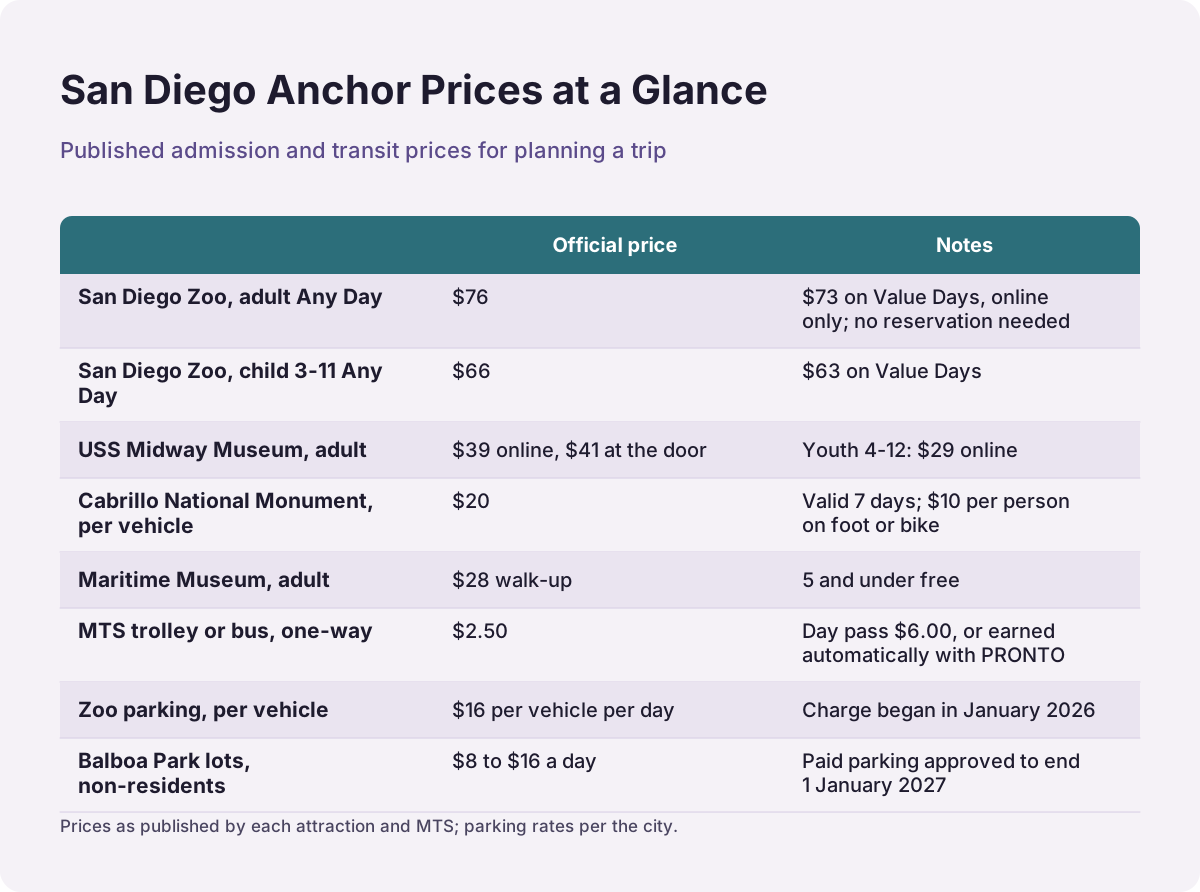
San Diego sits at the affordable end of coastal California, and its anchor prices are published and stable: Zoo admission is $76 for an Any Day adult ticket, the USS Midway Museum is $39 online and $41 at the door, and Cabrillo National Monument charges $20 per vehicle for seven full days. Los Angeles attraction pricing is heavier and more dynamic, with most headline experiences sold through dated or tiered tickets, so a comparable day there costs more before you add parking.
On the San Diego side you can plan a week against published figures. The Zoo's child Any Day ticket is $66, and the Safari Park's adult Value Day ticket is $73 online. The Maritime Museum is $28 at the walk-up window. None of these require a reservation: the Zoo explicitly needs no timed entry.
The three products above are the efficient spine of a San Diego budget: a two-day trolley ticket that replaces rental car days, a GoCar for the neighborhoods the trolley skips, and a Midway ticket bought online at the cheaper rate. The Midway's own visitor page publishes the online-versus-door split, and the online price is the one worth taking.

Los Angeles is harder to budget on paper. Its theme-park and studio tickets are date-based and move with demand, parking is charged separately at nearly every major venue, and the distances between venues add fuel, tolls and time. A useful planning habit: budget Los Angeles by attraction, San Diego by day. Our San Diego trip cost breakdown works through the local numbers line by line.
| San Diego anchor | Official price | Notes |
|---|---|---|
| San Diego Zoo, adult Any Day | $76 | $73 on Value Days, online only; no reservation needed |
| San Diego Zoo, child 3-11 Any Day | $66 | $63 on Value Days |
| USS Midway Museum, adult | $39 online, $41 at the door | Youth 4-12: $29 online |
| Cabrillo National Monument, per vehicle | $20 | Valid 7 days; $10 per person on foot or bike |
| Maritime Museum, adult | $28 walk-up | 5 and under free |
| MTS trolley or bus, one-way | $2.50 | Day pass $6.00, or earned automatically with PRONTO |
One cost trap on the San Diego side: parking. Zoo parking is $16 per vehicle per day, a charge that began in January 2026, and Balboa Park lots run $8 to $16 a day for non-residents, though City Council has approved removing Balboa Park's paid parking on 1 January 2027. The trolley exists precisely so you can skip those line items. Our parking in San Diego guide tracks every rate.
Which City Has the Better Beaches?
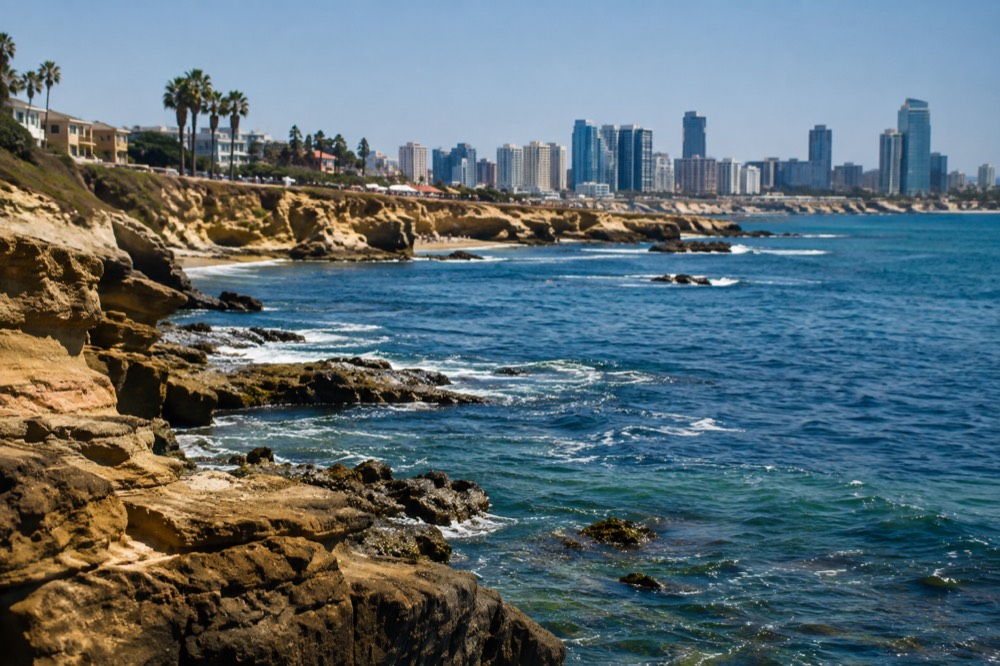
San Diego wins on beach quality and access. Its coastline mixes real wildlife encounters, La Jolla's sea caves and seals, with classic boardwalk culture at Mission and Pacific Beach, and the ocean is at its warmest in August at a mean of 68.7F off La Jolla. Los Angeles beaches are iconic and famous, but they are spread along a traffic-heavy corridor and the water is colder for most of the year.
The San Diego difference is variety within a short drive. La Jolla Cove offers snorkeling with sea lions and garibaldi in a protected marine area. Sunset Cliffs gives you sandstone bluffs and a free ocean sunset with no boardwalk noise. Mission Beach pairs a boardwalk and roller coaster at Belmont Park with wide sand. Torrey Pines puts a rare stand of the namesake pines above a wild beach with a reserve trail network. Each is a distinct experience, not a variation on one beach.
The water temperature story favors San Diego late in the year. Monthly averages at the La Jolla Scripps Pier station run 66.5F in July and peak at 68.7F in August, holding at 67.6F in September. That is warmer than most people expect from the Pacific, and it is why September swims feel better than June ones.
| San Diego beach | What it is best for |
|---|---|
| La Jolla Cove | Snorkeling with sea lions, calm protected water, sea caves |
| La Jolla Shores | Beginner surfing, kayak launches, families with small kids |
| Mission Beach | Boardwalk, Belmont Park rides, classic beach-day energy |
| Sunset Cliffs | Bluff walks, ocean sunsets, no crowds and no attractions |
| Torrey Pines State Beach | Wild sand below the reserve trails, hiking plus swimming |
| Pacific Beach | Young nightlife, pier, long boardwalk run |
The wildlife is the part Los Angeles simply cannot match. La Jolla's sea caves are kayakable on a guided tour, and the Cove's snorkeling puts you in the water with a resident sea lion colony. The guided two-hour kayak tour is the standard way in, and booking ahead matters in summer when launch windows fill.
Our La Jolla Cove guide and our best beaches in San Diego roundup cover the full coastline. Los Angeles counterpoints like Santa Monica and Malibu are genuinely famous, and the pier is worth a visit if you are there anyway, but the sand-to-traffic ratio favors San Diego in every season.
Is It Easier to Get Around San Diego or Los Angeles Without a Car?
San Diego is one of the few Southern California cities where a car-free trip is genuinely practical: the MTS trolley and buses charge $2.50 a ride with free two-hour transfers, a $6.00 day pass is earned automatically under PRONTO fare capping, and the Blue Line runs from the Mexican border to UC San Diego in a published 1 hour 23 minutes. Los Angeles without a car is possible but slow, with long rail gaps between the places tourists actually want to see.
The San Diego transit spine is real. The fare chart publishes $2.50 one-way and $6.00 for a day pass, and the PRONTO system caps automatically: keep tapping the same card or app and once your rides total the day-pass value, the rest of the day is free. There is no reason to buy a day pass up front. Youth 18 and under ride free entirely.
Downtown, Balboa Park, Old Town, the harbor and the border are all on or near trolley lines. There is no trolley station at the airport, but Route 992 runs every 15 minutes from both terminals to the downtown interchange for $2.50, and the free San Diego Flyer shuttle connects the terminals to Old Town Transit Center.

For the parts transit skips, the hop-on hop-off narrated trolley is the tourist-friendly layer: one ticket valid two days, hopping between downtown, the harbor, Balboa Park and Old Town with live narration. It is the single best answer to "I have two days and no car."
Two days of hopping covers the whole downtown core, and the narration fills in the history between stops. If you would rather drive yourself but skip the parking hunt, the two-hour GoCar tour covers downtown and Old Town or the beaches on a route the GPS story-guide walks you through.
Los Angeles rail has improved, but the geometry works against it: the region's attractions are scattered across a basin, and rail lines do not connect most of them to each other without a transfer downtown. Angelenos drive for a reason. Our getting around San Diego guide has the full transit detail, and the official fare chart at sdmts.com publishes every current fare.
Which City Wins on Food?
San Diego wins on seafood and Mexican food by a wide margin: the fish taco is the city's signature dish, the border is a trolley ride away, and the harbor lands fish at the downtown waterfront. Los Angeles wins on sheer range, with more Michelin-level dining and more regional Chinese and Korean food, at prices that reflect it. San Diego is the better eating city for a casual trip, Los Angeles for a foodie project.
The San Diego argument starts with geography. Tijuana is at the southern end of the Blue Line, and the cross-border influence shows everywhere: the Old Town tequila and tacos walking tour style of eating, the birria and the mariscos, the Baja-med fusion that local chefs built a reputation on. The gaslamp food tour walks the downtown version of that scene with drinks included.

Los Angeles counters with depth. Its San Gabriel Valley and Koreatown are national destinations in their own right, and its fine-dining bench is deeper than San Diego's by any measure. If your trip is organized around restaurant reservations, Los Angeles is the stronger pick. If it is organized around eating well between beach stops, San Diego's Little Italy and North Park neighborhoods deliver without the reservation scramble.
Beer belongs in this conversation too. San Diego is one of the country's defining craft-beer cities, with a brewery culture that Los Angeles has never matched per capita, and the North Park Beerucation Tour builds a whole afternoon around explaining why. The full index of guides sits on Things to Do in San Diego.
Which City Has Better Weather, and When Should You Visit?
Both cities share Southern California's dry-summer climate, but San Diego runs cooler and greyer at the coast in early summer: June's normal high of 71.7F is lower than October's 74.6F, because the marine layer locals call May Gray and June Gloom sits on the beaches while inland areas stay clear. The counterintuitive peak is September, when the normal high of 77.2F beats July's by 1.9F and the ocean holds its summer warmth.
The 30-year climate normals from NOAA's National Centers for Environmental Information, published at ncei.noaa.gov, tell the story plainly. San Diego's warmest normal high is August's 77.3F, with September a tenth of a degree behind. Rain is a winter phenomenon: December through March carry most of the year's measurable precipitation, and August averages one hundredth of an inch.
Los Angeles runs a few degrees warmer than San Diego on average and gets more inland heat, which is a plus in spring and a minus in late summer when the basins cook. The marine layer affects both coasts, but San Diego's beach districts feel it more because the city's visitor core sits right on the water.
| Month | Normal high F | Normal low F | Mean ocean temp F |
|---|---|---|---|
| June | 71.7 | 62.6 | 64.0 |
| July | 75.3 | 66.1 | 66.5 |
| August | 77.3 | 67.5 | 68.7 |
| September | 77.2 | 66.2 | 67.6 |
| October | 74.6 | 61.5 | 64.0 |
The planning takeaway: visit San Diego in September if you can, and see our September in San Diego guide for what is open. Visit Los Angeles in spring or fall to dodge the inland heat. And do not plan a June beach trip in either city expecting relentless sunshine; the grey mornings are real, and they usually burn off by early afternoon.
Which Is Better for Families: San Diego or Los Angeles?
San Diego is the stronger family city for a first trip: the Zoo needs no timed entry, the Safari Park is an easy day out, SeaWorld and LEGOLAND are both in county, and the harbor has a density of kid-pleasing ships, from the Midway's flight deck to the Maritime Museum's historic vessels. Los Angeles competes hard on theme parks, with Disneyland a short drive from its core, but its everyday sightseeing involves more driving between stops.
The San Diego family stack is unusually deep. The Zoo's child ticket is $66 and children under 3 enter free; the Midway is free for children 3 and under and for active duty military; Cabrillo's tidepools are a genuine natural-world experience inside a national monument. LEGOLAND California sits up in Carlsbad with a kids-from-$39 online offer when bought with an adult ticket, an offer that runs through November 1, 2026, and its operating calendar closes on some off-season weekdays, so check the park's own calendar before you commit to a date.
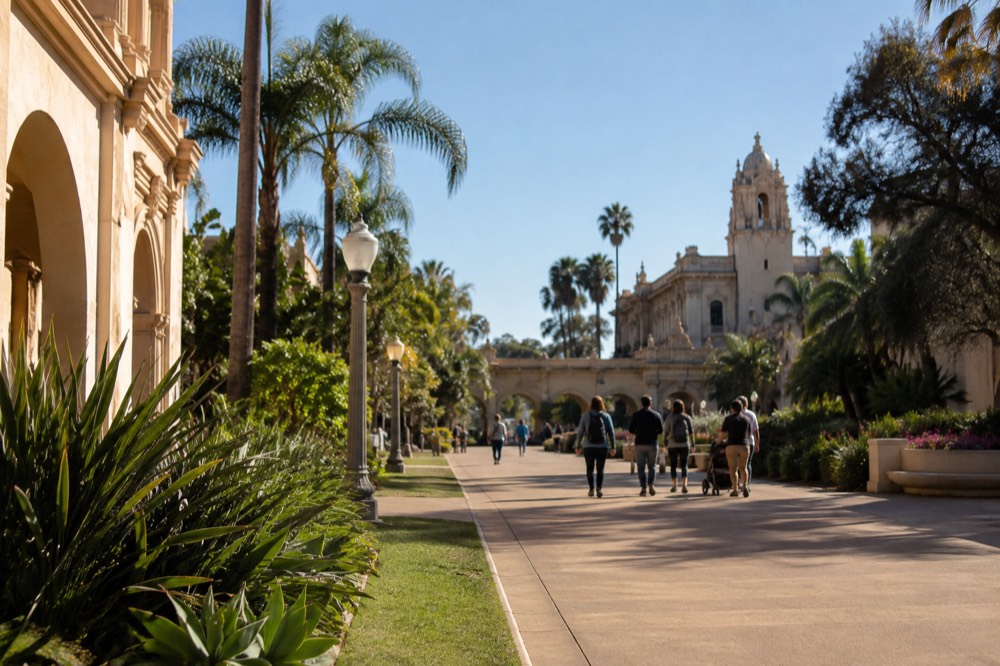
Balboa Park is the quiet family weapon. The grounds, gardens and Botanical Building are free, the Spreckels Organ Pavilion runs free Sunday concerts at 2:00 pm year round, and the park's free tram loops the lots from 8:00 am to 8:00 pm. Our San Diego with kids itinerary sequences the whole week.
Los Angeles's family case rests on Disneyland in Anaheim and the studio-adjacent attractions, which are superb but consume entire days and entire budgets. San Diego spreads its family appeal across half-day experiences, which survives nap schedules and short attention spans far better.
How Do You Split a Trip Between San Diego and Los Angeles?
The two cities are close enough that splitting a week is practical, and the standard split favors San Diego as the base: three or four nights in San Diego covers the Zoo, Balboa Park, the harbor and La Jolla at a relaxed pace, then two or three nights in Los Angeles for the studio and Hollywood sights. Driving between them is straightforward along the coast route, though the inland freeway is faster; the border and Tijuana day trips only work from a San Diego base.
The sequencing logic is about energy. San Diego's attractions are restful: beaches, a park, a harbor cruise, tidepools. Los Angeles's are transactional: tickets, times, queues. Most travelers enjoy the relaxed city first and the scheduled one second, arriving in Los Angeles already on west-coast time with the beach portion of the trip banked.
If you only have one city, let your must-see list decide. One USS Midway flight deck, one afternoon of La Jolla sea caves, one Gaslamp dinner crawl: that is a San Diego trip. Studio lots and the Hollywood sign: that is Los Angeles. Our San Diego 2-day itinerary and the first time in San Diego guide build the San Diego half, and our Los Angeles overview handles the other base.
One border note if you are combining the trip with Tijuana: US citizens need a passport book, passport card, enhanced driver's license or Trusted Traveler card to re-enter by land, and visa-waiver visitors need a valid ESTA before land entry. San Ysidro is the busiest land crossing in the western hemisphere, so check the live CBP wait-time feed rather than any quoted "usual" wait. Our Tijuana guide covers the crossing in full.
Common Questions About San Diego vs Los Angeles
Which city is cheaper to visit, San Diego or Los Angeles?
San Diego is generally cheaper once you account for transport. Its anchor prices are published and stable, Zoo admission at $76, the Midway at $39 online, a $2.50 trolley fare, and a car-free week is realistic. Los Angeles adds parking at nearly every venue and more driving between them.
Is San Diego better than Los Angeles for beaches?
Yes, for most travelers. San Diego's beaches are more varied, the water is at its warmest in August and September, and the wildlife at La Jolla, sea lions, leopard sharks, garibaldi, has no Los Angeles equivalent. Los Angeles beaches are famous but colder and traffic-bound.
Can you visit San Diego without a car?
Yes, comfortably. The trolley and buses charge $2.50 a ride, PRONTO caps fares at the $6.00 day-pass rate automatically, and downtown, Balboa Park, Old Town and the border are all transit-connected. The airport has no trolley station but Route 992 runs every 15 minutes to the downtown interchange.
Which city is better for families with young kids?
San Diego. The Zoo, Safari Park, LEGOLAND, SeaWorld and the Midway are all in county, most need no timed entry, and Balboa Park's grounds, gardens and Sunday organ concerts are free. Los Angeles's family highlights, chiefly Disneyland, consume full days and bigger budgets.
What is the best month to visit San Diego?
September. Its normal high of 77.2F beats July's by 1.9F, the ocean holds near its annual peak at 67.6F, and it is the quietest month at Cabrillo National Monument, with a 48 percent visitation gap against July across 2022-24. Avoid June if you want guaranteed beach sun, since the marine layer is at its thickest.
Is it worth visiting both San Diego and Los Angeles on one trip?
Yes, if you have at least six nights. Three or four in San Diego as the relaxed base, then two or three in Los Angeles for the studio and Hollywood sights. Keep Tijuana and the border day trips on the San Diego side of the split, since the crossing is at the southern end of the Blue Line trolley.