Torrey Pines State Natural Reserve: Trails, Beach Access and Planning Guide
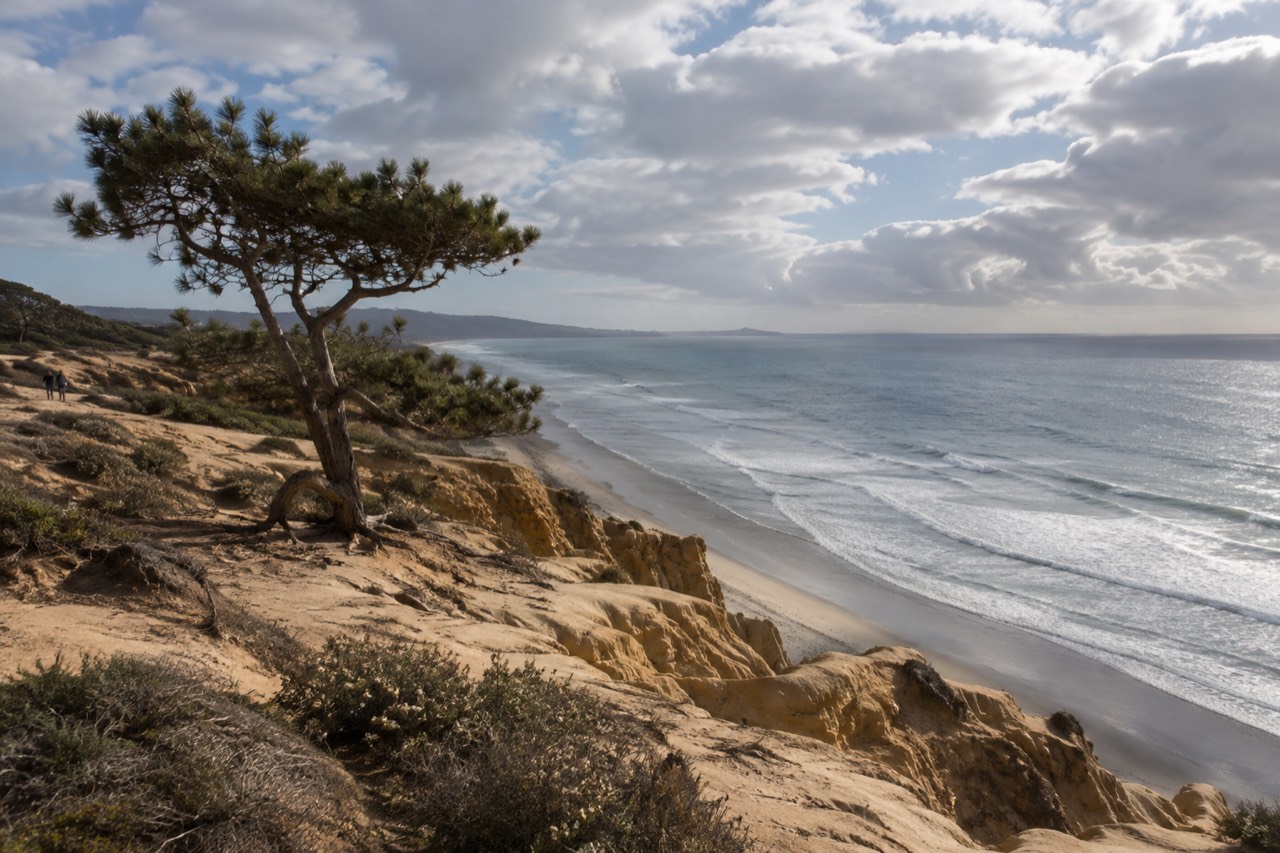
A clifftop stand of one of the world's rarest pines, sitting above a wild beach in the middle of San Diego's coastal strip. Here is how to hike Torrey Pines well.
Short answer
Torrey Pines State Natural Reserve protects a rare pine that grows naturally in only a handful of places, on sandstone bluffs between La Jolla and Del Mar. Entry to the reserve itself is inexpensive, the trail network is compact, and the Beach Trail drops to a shoreline most visitors never reach. Go early, bring water, and check the official park page before you drive.
A strip of sandstone cliff north of La Jolla holds one of the rarest trees on earth. The Torrey pine grows wild in only a few places, and the largest protected stand of them sits inside a state reserve that most San Diego visitors drive past on the way to somewhere else. That is a mistake. The reserve packs bluffs, a lagoon, a wild beach and views down the whole coast into a walkable pocket, and it sits minutes from some of the busiest neighborhoods in the city.
This guide covers what the reserve is, how to plan a visit, what each trail actually delivers, and how to fold it into the rest of a San Diego itinerary. It also covers the honest practical questions: parking, the marine layer that greys the coast for half the year, and what the beach at the bottom of the cliffs is really like.
What Is Torrey Pines State Natural Reserve?
Torrey Pines State Natural Reserve is a protected coastal park between La Jolla and Del Mar, safeguarding the largest wild stand of the Torrey pine, a tree that grows naturally in only a handful of locations worldwide. The reserve pairs the pine forest with sandstone bluffs, eroded badlands and a beach, all inside the city limits. It is a state natural reserve rather than an ordinary park, which is why the rules are stricter and the landscape has stayed wild.
A state natural reserve is a specific California designation, a notch above a regular state park in terms of protection. The intent is to preserve rare or fragile ecology, and Torrey Pines qualifies twice over: the namesake pine, and the plant communities living on the unprotected sandstone. That designation shapes your visit more than you might expect. No dogs, including in vehicles in some zones, no food on the trails, no climbing on the cliffs, and a general expectation that you stay on designated paths.
The reserve also includes the beach below the bluffs and the lagoon at the north end where Los Peñasquitos Creek meets the ocean. So a single visit can move through three completely different landscapes in a couple of hours: pine and scrub on the mesa top, sculpted sandstone on the cliff edges, and open shoreline at the bottom. Few city parks anywhere offer that range in this small a space.
The visitor center sits in a small adobe-style building near the main entrance, with natural history displays and restrooms. It is worth ten minutes on your way in, mostly for the context on why this particular patch of coast was never developed.
How Do You Plan a Visit: Entry, Parking and Timing?
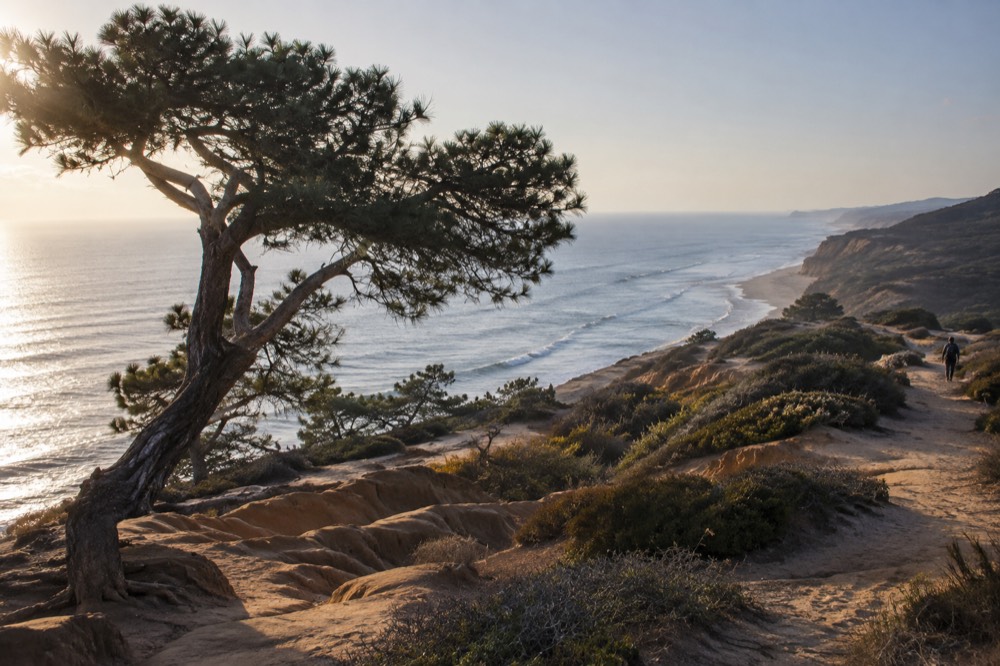
Entry to the reserve is inexpensive by big-attraction standards, but parking is the real constraint, and the lots fill on weekends and clear days. The reserve enforces quiet rules: no dogs, no food on trails, no drones. Arrive before mid-morning on any weekend or holiday, check the official state park page for current hours and any closures before you drive, and treat the marine layer as a planning factor rather than a surprise.
Start with the official source. Hours, entry fees and lot status for the reserve are published by California State Parks, and the reserve's own page is the only place to confirm same-day conditions, since closures for maintenance or fire danger do happen. Do not rely on a search result or an old blog post for the fee or the hours, both have changed over the years and neither is worth guessing at.
Parking is the honest headline. The main lot at the top of the mesa and the beach lot below are both small relative to demand, and on a clear Saturday they are functionally full by mid-morning. Street parking near the reserve is limited and the surrounding streets are residential. The practical advice is simple: come early, or come on a weekday, or accept that you may be circling. This site publishes honest parking guidance for the whole city in its San Diego parking guide, and the same early-arrival logic applies here more than almost anywhere.
The marine layer matters more here than at inland sights. The coastal strip from La Jolla northwards sits under grey cloud for much of May and June, a pattern locals call May Gray and June Gloom, and it can linger into July mornings. It almost always burns off by early afternoon, so a grey 8 am start often becomes a blue-sky 11 am. If you want photographs with light on the water, plan for the afternoon. If you want a quiet trail and a parking spot, come early and accept the grey.
If the reserve is one stop on a bigger trip that includes ticketed attractions, it is worth thinking about how the costs stack up before you buy anything:
The reserve itself costs little, so it rarely drives a budget decision on its own. But if you are pairing a morning on the bluffs with the USS Midway downtown or a LEGOLAND day with kids in Carlsbad, a bundled pass can change the math, and the pass pages let you compare before committing.
What Are the Trails Actually Like?
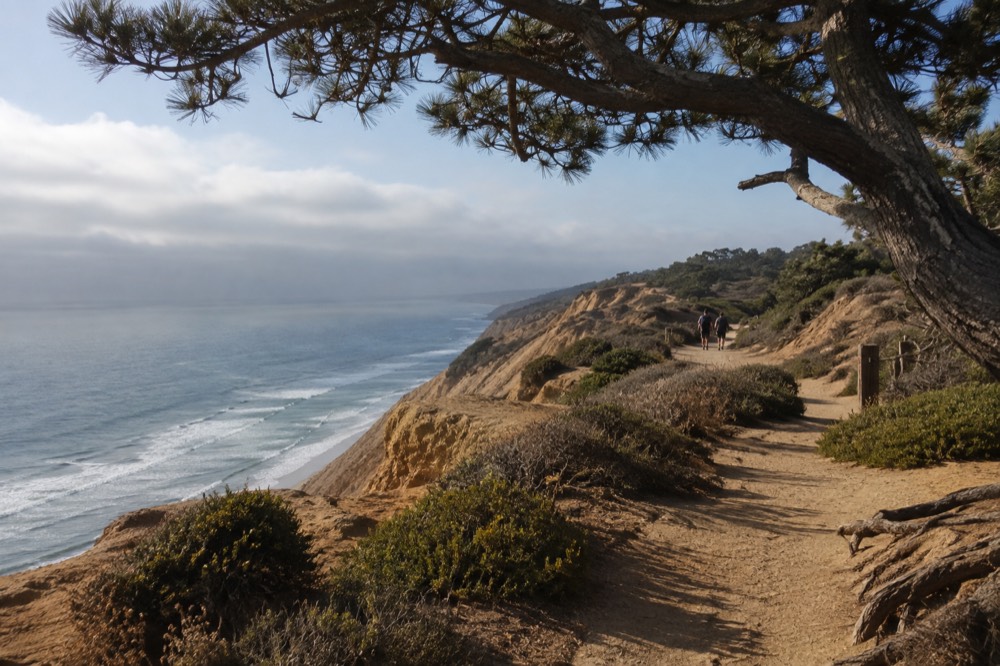
The reserve's trail network is compact, a handful of interlinked paths on the mesa top, none of them long by hiking standards. The Guy Fleming Trail is the gentle loop with the best overall views, the Beach Trail is the one that drops to the ocean, and the Parry Grove and Razor Point trails lead to cliff-edge lookouts over sculpted sandstone. Everything is well signed, and you can combine two or three routes into a single visit without overdoing it.
The Guy Fleming Trail is the one to start with if it is your first visit. It is a loop through the pine stand itself, mostly level, with two overlooks that frame the tree cover against the ocean. Because it stays on the mesa, it works for almost any fitness level and for older visitors who want the scenery without the climb back up.
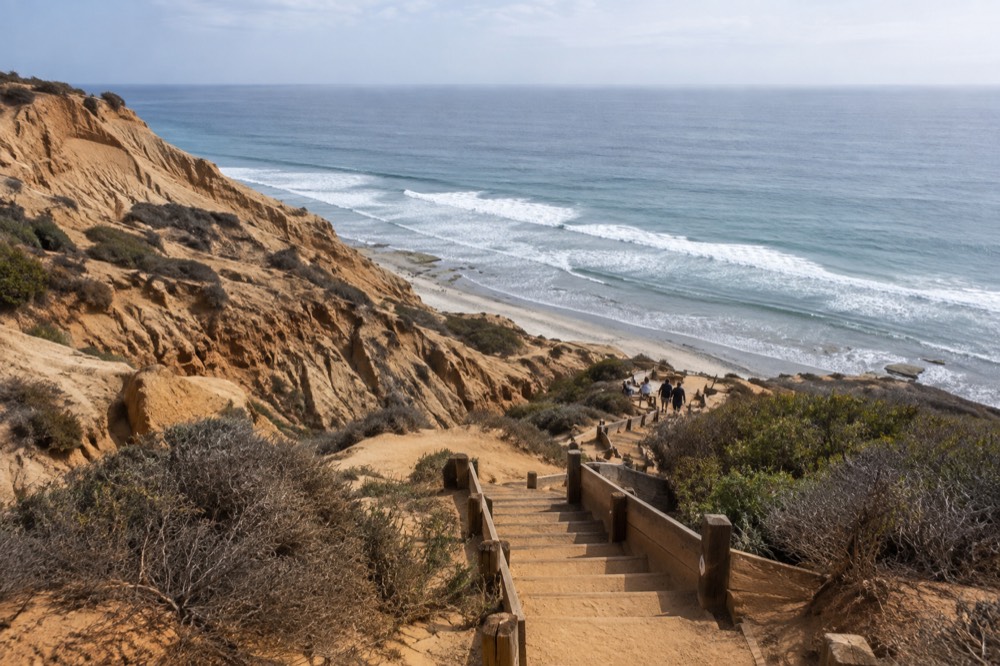
The Beach Trail is the reserve's signature walk. It starts near the visitor center and descends through the pine cover, then down the face of the bluff via a series of switchbacks and steps cut into the sandstone, emptying onto a wild beach that stretches for miles. The descent is the easy half. Coming back up is a real climb on sand and stairs, so budget your energy and carry water. The beach itself is unstaffed in the sense that you should treat it as a natural shoreline, not a lifeguarded swimming beach, and the cliffs are strictly off-limits for climbing.
Razor Point and the Yucca Point overlooks are the geology showpieces. The sandstone here is soft, badly eroded in the most photogenic way possible, and the viewpoints hang right over formations that look more like the desert than the coast. Parry Grove is a short, quiet spur through a native plant garden and grove, often the emptiest corner of the reserve.
A quick comparison of the main routes, described by character since conditions and exact lengths are best confirmed on the park's own materials:
| Route | Character | Best for |
|---|---|---|
| Guy Fleming Trail | Level loop through the pine stand, two ocean overlooks | First visits, easy pace, accessibility-minded groups |
| Beach Trail | Descending trail with steps and switchbacks to the shoreline | The classic Torrey Pines experience, beach time |
| Razor Point Trail | Cliff-edge route over heavily eroded sandstone | Geology, photography, big views |
| Parry Grove Trail | Short, quiet spur through native planting | Solitude, plant life, a slow second lap |
| Broken Hill Trail | Longer route across the reserve's interior mesa | A quieter alternative when lots and loops are busy |
One warning worth repeating: the cliffs are actively eroding, which is exactly why they look the way they do. Stay behind fences and on the trail. The sandstone edges are unstable, and every year the ocean takes a little more of them. If you are pairing this walk with other hiking around the county, our San Diego hiking guide ranks where this fits among the region's bigger climbs.
Is the Beach Below the Cliffs Worth the Walk Down?
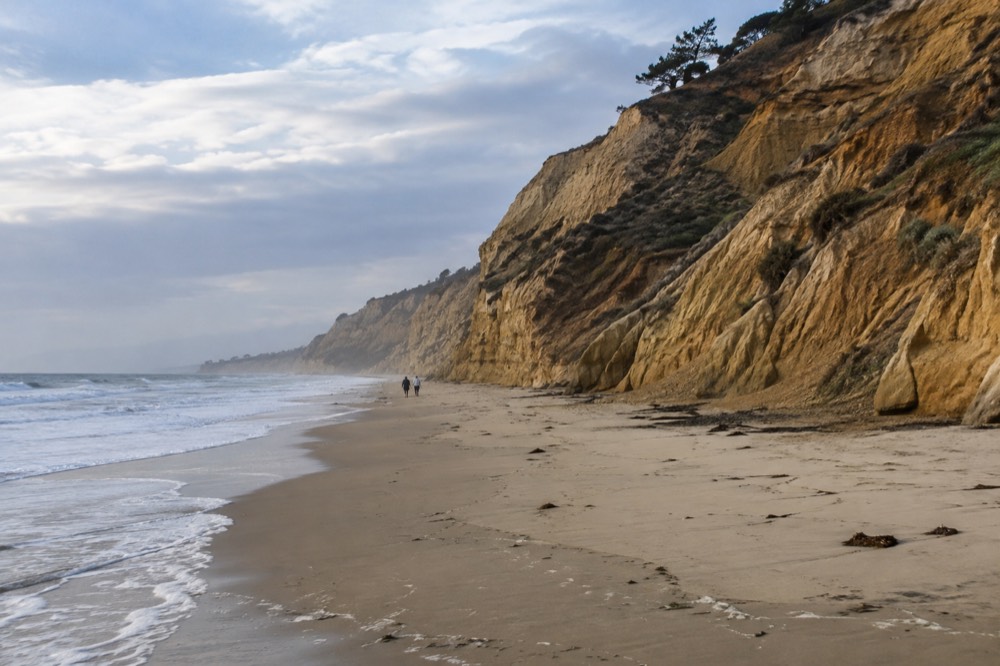
Yes, and for many visitors it is the best part. The beach at the bottom of the Beach Trail is a long, often near-empty stretch of sand hemmed by the bluffs on one side and open ocean on the other, dramatically quieter than the city beaches to the south. The trade-offs are real: no amenities to speak of, no easy exit except the trail you came down, and surf conditions that demand respect. Walk it, look at it, and swim only if you know what you are doing.
The contrast with Mission Beach or Pacific Beach, a few miles south, is the whole point. Those are the city's social beaches: boardwalks, rentals, volleyball and crowds. The Torrey Pines shoreline is what the coast looked like before all of that. On a weekday morning you can walk a long stretch and share it with a handful of people and the occasional pelican formation.
Two safety notes, both from official city sources. Rip currents are the primary hazard on San Diego's coast, and the city's lifeguard division publishes the standard advice: stay calm, swim parallel to the shore until the pull relaxes, then angle in, and swim near a lifeguard whenever possible, as the city's rip current guidance sets out. This beach sits at the wilder end of the city's roughly 24 miles of staffed coastline, so treat it accordingly. Second, water quality after rain can close sections of the coast, and the county posts same-day results at its beach water quality page, which is the right thing to check after any storm.
Alcohol is prohibited on San Diego's beaches and boardwalks, and glass containers are too, so plan the picnic for the top of the mesa where rules allow or leave it for after the hike. Our guide to San Diego's best beaches covers where the lifeguarded, amenity-rich alternatives are if the wild version sounds like too much.
When Is the Best Time of Year to Visit?
Any month works, because San Diego's coastal climate stays mild year round, but the character of the visit changes with the season. Late summer and early fall bring the warmest air and the warmest ocean, with September's normal high of 77.2F actually beating July's. May and June are the grey months under the marine layer. Winter brings the fewest crowds, occasional rain and the gray whale migration passing offshore.
The climate data tells a story that surprises first-time visitors. September, not July, is effectively San Diego's real summer: its normal high of 77.2 degrees sits just a tenth behind August's 77.3 and nearly two degrees above July's 75.3, and the ocean is at its warmest of the year in August at a mean of 68.7F. Yet September is one of the quietest months on the whole coast, because the school calendar, not the weather, drives the crowds. A September morning at Torrey Pines gives you warm air, warm water at the bottom and thin trails.
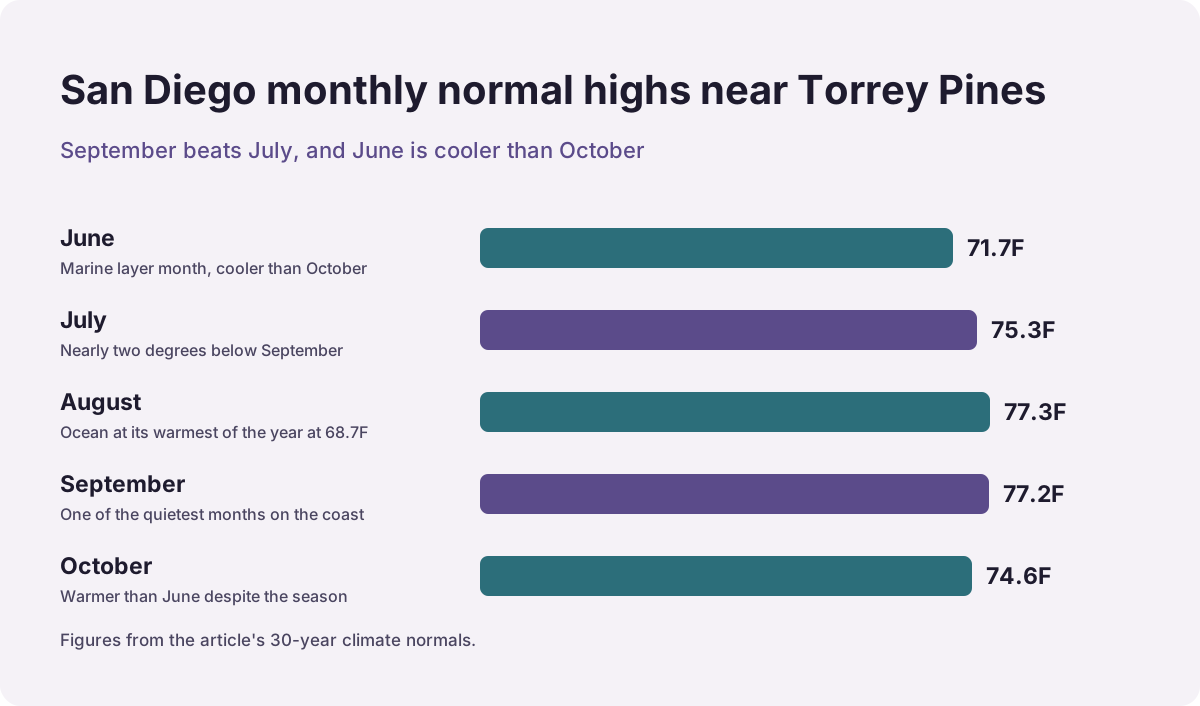
May and June are the marine layer months. June's normal high of 71.7F is lower than October's 74.6F, a fact visible in the 30-year climate normals themselves, and the grey mornings that locals call May Gray and June Gloom are the reason. The pattern burns off most days by late morning, so the fix is simply scheduling: hike early for solitude and grey softness, or start later and trade crowds for blue sky.
December through March is the rain window, when nearly all of the year's measurable precipitation falls, but the storms are brief and the clear winter days are spectacular, with the clearest air of the year for views down the coast. Winter also brings the gray whale migration past San Diego, with more than 20,000 gray whales passing offshore each year, most visible from the coast in late December through February. The bluff overlooks here are legitimate land-based whale watching spots on a calm morning. Our Cabrillo National Monument guide covers the park that runs the region's dedicated whale watching programming if you want the organized version.
What Should You Bring, and What Are the Rules?
Bring more water than you think you need, sun protection for the exposed sections, and shoes with grip for the sandstone steps. The rules that matter: no dogs anywhere in the reserve, no food on the trails, no climbing the cliffs, no drones, and stay on designated paths. The reserve is a protected ecological site first and a recreation area second, and the enforcement reflects that.
The no-dog rule is the one that catches visitors most often, and it applies to the whole reserve including the trails and the beach, so leave pets at home rather than in the car. Food is restricted on the trails to keep wildlife and the fragile plant communities undisturbed; eat at the designated areas near the entrance or the visitor center. Drones are prohibited, which matters if you are a photographer, and the cliff formations are closed to climbing, which matters if you are a scrambler.
Water is the practical item people underestimate. The Beach Trail climb back up faces the sun for long stretches, the sandstone radiates heat on clear afternoons, and there is no water or food service on the trails. Sun protection matters even under the marine layer, since the grey light still carries ultraviolet exposure. Grip matters more than stiffness in footwear: the steps and switchbacks are sand and worn stone, slick in morning damp.
| Item | Why it matters at Torrey Pines |
|---|---|
| Water, more than usual | The return climb is exposed, with nothing on the trails |
| Grippy shoes | Sandstone steps and sandy switchbacks, damp in the morning |
| Sun protection | The marine layer still lets UV through, and afternoons are bright |
| Layers | Grey 8 am often becomes warm 11 am, then cool again on the beach |
| Binoculars | Pelicans, raptors over the bluffs, and gray whales in winter |
How Does Torrey Pines Compare with Other San Diego Coastal Walks?
Torrey Pines is the best pure clifftop hike inside the city, but it is not the only one. Sunset Cliffs offers ocean-edge walking with no climb and no entry logistics, La Jolla Cove pairs a short coastal path with seals and sea lions, and Potato Chip Rock is the inland option when you want a real summit workout. Torrey Pines wins on the combination of rare landscape, wild beach and manageable scale.
Sunset Cliffs Natural Park, down the coast in Point Loma, is the closest substitute in spirit: sandstone, ocean and dramatic light. The difference is structure. Sunset Cliffs is mostly flat shoreline walking with the cliffs beside you, while Torrey Pines has elevation, a trail network and a beach you have to earn. Our Sunset Cliffs guide covers it in full, and it is the better pick for a sunset stroll or for visitors who cannot manage the stairs.
| Coastal walk | Elevation | Signature feature | Best for |
|---|---|---|---|
| Torrey Pines Reserve | Real climbs, stairs and switchbacks | Rare pines, eroded bluffs, wild beach | A half-day hike with a payoff |
| Sunset Cliffs | Minimal | Ocean-edge sandstone and sunset light | Easy evening walks, photography |
| La Jolla Cove | Gentle | Seals, sea lions and the cove itself | Wildlife, swimming, families |
| Potato Chip Rock (inland) | Strenuous | Summit rock formation | A workout and a photo |
La Jolla Cove, a few miles south, is the wildlife alternative, with the sea lion and seal viewing that Torrey Pines cannot match. Our La Jolla Cove guide and the La Jolla neighborhood guide cover the practical side, including the seasonal protections around the marine mammals that change what you can do and where. Note that the La Jolla sea lion and seal rules shift by season, so check current conditions rather than assuming.
If you are building a whole coastal day rather than a single hike, the natural pairing is Torrey Pines in the morning, La Jolla for lunch and the cove in the afternoon, and that sequence is exactly what our one day in San Diego itinerary sketches out for first-timers.
How Do You Fit the Reserve Into a Bigger San Diego Trip?
Give Torrey Pines a half day at most, and slot it either early morning before a downtown afternoon or as the quiet start to a coastal day heading south through La Jolla. It pairs naturally with the USS Midway or the Embarcadero downtown, roughly 20 minutes away by car, and it is the closest thing to a wilderness experience the central city offers. Most visitors combine it with one ticketed attraction and one meal stop.
The geography works in your favor. The reserve sits right off the coast highway between La Jolla and Del Mar, so it is a natural first stop on a north-county day that continues through Del Mar or Carlsbad, or a natural early stop on a day that finishes downtown. The USS Midway Museum on the Embarcadero is the classic downtown pairing, a ship you can board and explore for a couple of hours, and the entry ticket is the kind of fixed-price sight that is easy to schedule around a morning hike.
If the trip includes kids, the split looks different. LEGOLAND California in Carlsbad sits north of the reserve up the coast, and a Torrey Pines morning plus an afternoon in the park is a genuinely good family day, with the hike burning off enough energy to make the theme park crowds survivable. LEGOLAND's tickets are dynamic by date, so the live listing is the only place to compare days.
For adults, the pairing that keeps coming up in reviews is the reserve in the morning and a harbor cruise or food tour in the evening, which balances the quiet natural half of the day with the social half. The Gaslamp Quarter guide and our San Diego nightlife guide cover where that evening half lands. If the whole trip is still taking shape, the first time in San Diego guide is the place to start, and Things to Do in San Diego keeps a running list of what is worth booking ahead and what is not.
One budget note worth knowing before you buy anything. The reserve is cheap, the Balboa Park museum cluster mostly cannot be booked through this site at all and is bought at the gate, and the big ticketed sights, the Zoo, the Midway, LEGOLAND, SeaWorld, are where a bundled pass starts to pay for itself. The CityPASS-style option bundles several of those headline sights at a discount, and it is the one product that changes the arithmetic of a multi-attraction week.
Whichever way you build the day, the reserve rewards being the quiet half of it. A morning on the bluffs, a climb down to empty sand, and then the city's louder attractions in the afternoon is a rhythm that works for almost every kind of traveler, from families with school-age kids to couples on a long weekend. The three options below cover the most common pairings visitors book alongside a coastal morning.
Common Questions About Torrey Pines State Natural Reserve
How long does a visit to Torrey Pines State Natural Reserve take?
Most visitors spend two to three hours, which covers the Guy Fleming loop plus the Beach Trail descent and some beach time. Add an hour if you want the Razor Point overlooks, and more if you plan to linger on the sand. The compact trail network means you will not need a full day.
Is Torrey Pines State Natural Reserve good for beginners and kids?
The Guy Fleming Trail is level and works for nearly everyone, including kids and older visitors. The Beach Trail is manageable for reasonably fit beginners but the climb back up is a real effort on stairs and sand. Bring more water than feels necessary, especially with children.
Can you swim at the beach below the reserve?
You can, but treat it as a natural shoreline rather than a lifeguarded city beach. Rip currents are the primary hazard on this coast, so follow the standard advice: stay calm, swim parallel to the shore until the pull relaxes, then angle back in. Check the county's beach water quality page after any rain before getting in.
Are dogs allowed at Torrey Pines State Natural Reserve?
No. Dogs are prohibited throughout the reserve, including on the trails and the beach, and leaving one in a vehicle is not a workaround. The designation as a natural reserve is what drives the strict rules, which also include no food on the trails, no drones and no climbing the cliffs.
What is the best time of day to visit?
Early morning for parking and solitude, late morning onward for sunshine, since the marine layer usually burns off by early afternoon. September is the sweet spot overall: it is among the warmest months of the San Diego year, the ocean is near its warmest, and the crowds are thin because school is back in session.
What is the best time of year to visit?
Any month works, but September and early fall combine the year's warmest air and water with the quietest trails. May and June bring grey marine-layer mornings that clear by late morning. Winter offers the clearest air for views and the gray whale migration passing offshore from late December through February.