The Best Photography Spots in San Diego: Coastline, Skyline and Golden Hour
San Diego gives photographers an unusual combination: a walkable downtown skyline on a working harbor, seventy miles of varied coastline, and a climate where the warmest, clearest light of the year arrives in September, after most visitors have gone home.
Short answer
The best photography spots in San Diego cluster around La Jolla Cove, Sunset Cliffs Natural Park, Cabrillo National Monument, the Embarcadero waterfront and Balboa Park. September delivers the warmest normal highs, 77.2F, and the warmest ocean of the year. Gray whales pass offshore from mid-December through March, and the marine layer softens coastal light each morning from May through June.
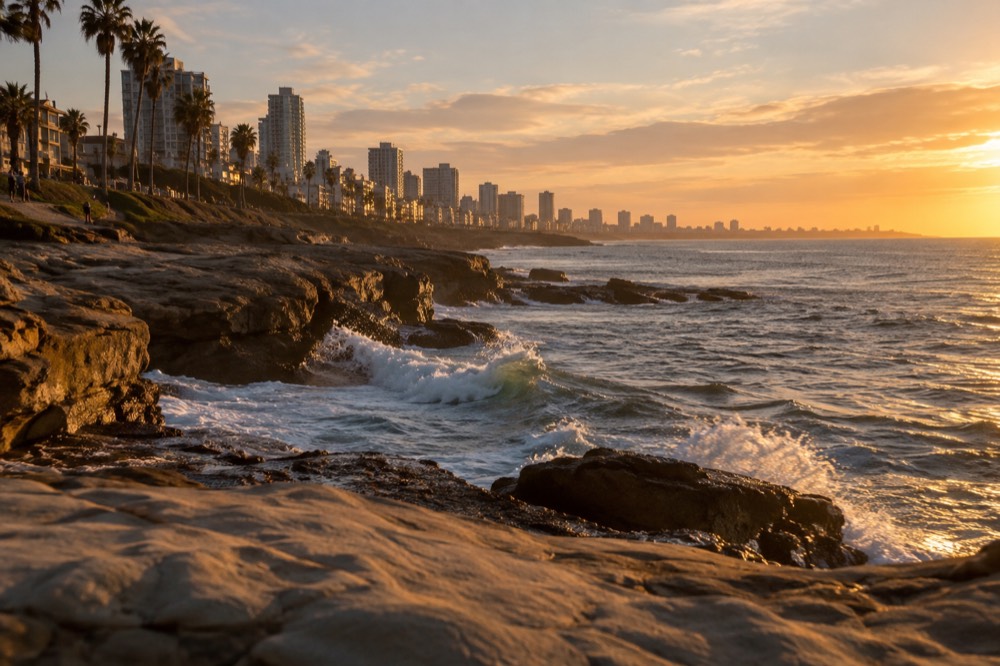
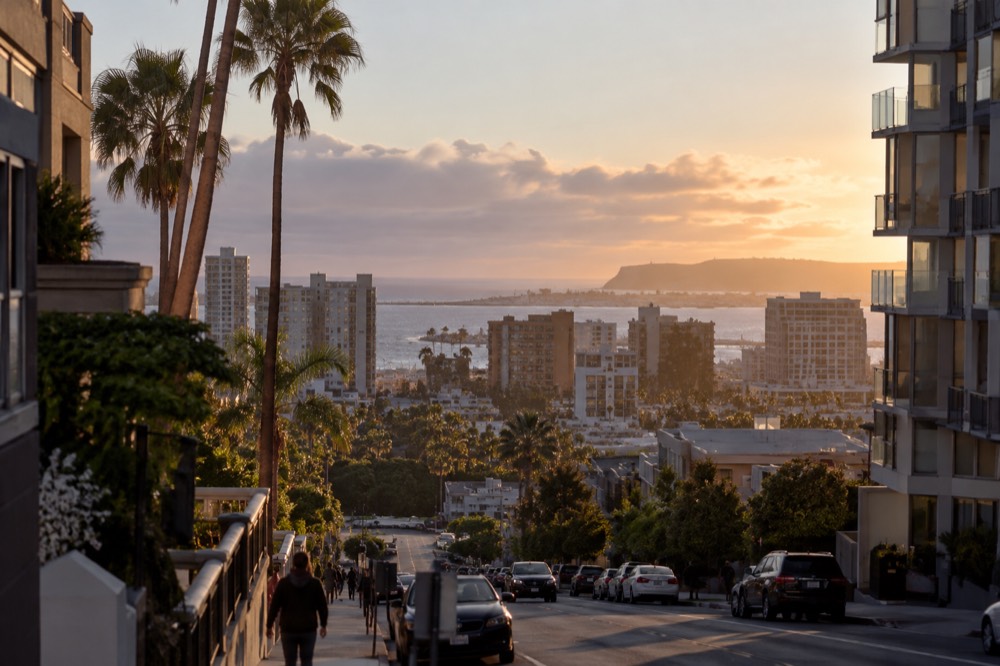
San Diego is a city that rewards photographers who plan around light rather than around landmarks. The coastline here is not one long beach but a sequence of very different scenes: sea caves carved into sandstone at La Jolla, vertical drop-offs at Sunset Cliffs, a historic lighthouse above tidepools at Point Loma, and a working harbor where aircraft carriers and fishing boats share the frame with the downtown skyline. The climate does the rest. The normal high in September, 77.2F, is warmer than July's, and the ocean off La Jolla reaches its yearly peak of 68.7F in August before easing to 67.6F in September. The crowds, meanwhile, thin. This guide walks through where to shoot, when the light is right, and what each location actually looks like through a viewfinder.
What Are the Best Photography Spots in San Diego?
The strongest photography spots in San Diego are La Jolla Cove and its sea caves, Sunset Cliffs Natural Park, Cabrillo National Monument, the Embarcadero along the harbor, Coronado Beach with the Hotel del Coronado, Balboa Park's gardens and Spanish colonial architecture, and the Gaslamp Quarter after dark. Together they cover coastline, skyline, wildlife, architecture and night work, and every one of them is reachable without a car if you base yourself downtown.
That list is deliberately compact. San Diego is a big county, but the scenes that consistently produce strong images sit inside a corridor running from La Jolla in the north, down the bayfront, and out to Point Loma. A photographer with three days can work all of them without rushing. The one day in San Diego itinerary covers the same corridor for travelers who want to pair shooting with sightseeing, and the logic is the same: the coast and the bay are close together, and the light changes fast.
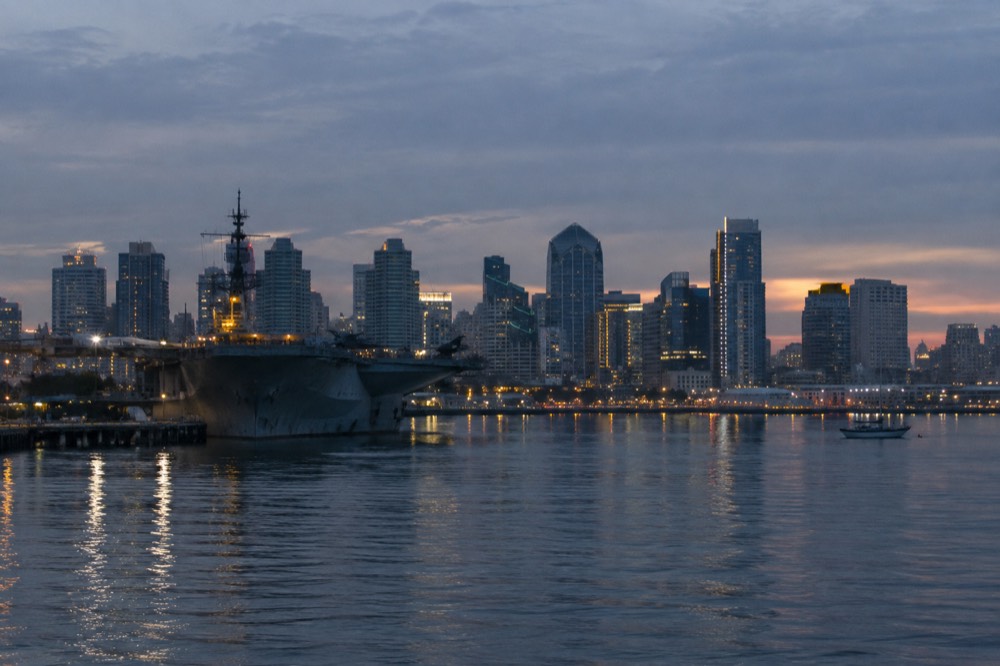
What separates San Diego from most West Coast photography cities is the harbor. Very few places in the country let you frame a modern downtown skyline across open water from a public waterfront path, with a decommissioned aircraft carrier in the foreground. The USS Midway Museum sits at the foot of Broadway Pier, and its flight deck is one of the most recognizable foreground objects on any American waterfront. Shoot it from the north side of the Embarcadero in late afternoon, when the sun is behind you and the skyline lights up.
The table below is the short version of this whole guide: where to go, what each spot gives you, and when the light cooperates.
| Location | What you shoot there | Best light |
|---|---|---|
| La Jolla Cove | Sea caves, turquoise water, sea lions, pelicans | Morning to midday |
| Sunset Cliffs Natural Park | Sandstone cliffs, wave action, open ocean sunset | The hour before sunset |
| Cabrillo National Monument | Old Point Loma Lighthouse, tidepools, bay panorama | Late afternoon |
| Embarcadero and Broadway Pier | Skyline, USS Midway, harbor traffic | Afternoon and blue hour |
| Coronado Beach | Hotel del Coronado, wide sand, silhouettes | Sunset from the north end |
| Balboa Park | Gardens, arches, Spanish colonial facades | Early morning, soft light |
| Gaslamp Quarter | Neon signs, historic facades, street scenes | After dark |
Where Should You Shoot the San Diego Skyline and Harbor?
The best skyline photography in San Diego happens along the Embarcadero from the USS Midway north to Broadway Pier, and from the water itself. Late afternoon gives you front-lit towers over the bay, blue hour brings the building lights up while the sky still holds color, and a harbor cruise or sailboat puts the whole skyline in one frame with the Coronado Bay Bridge as a second subject.
The Embarcadero is a public waterfront promenade, free to walk, and it faces the skyline dead on. Work the stretch between the Midway and Seaport Village and you get three foreground options in a fifteen minute walk: the carrier itself, the fishing fleet at the G Street Pier, and the sailboat masts of the marina. Each one changes the character of the frame completely. The carrier is monumental, the fishing boats are documentary, the masts are graphic. If you want the classic postcard, shoot from the area around the Maritime Museum of San Diego, where the historic ships, including the steel-hulled Star of India, sit in the foreground water.
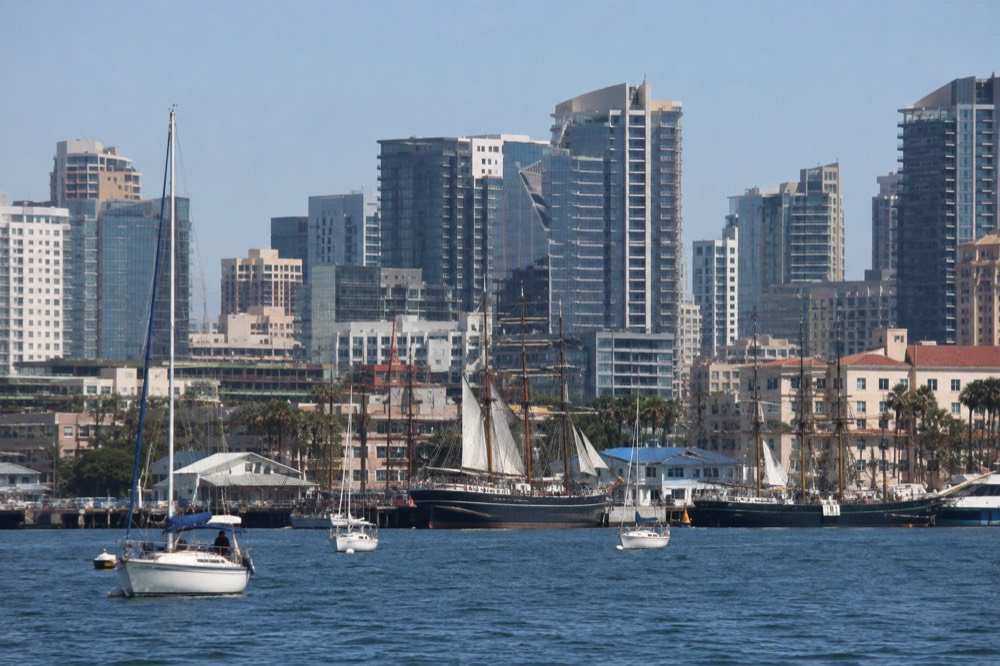
The perspective from land is good, but the perspective from the water is the one most photographers miss. From a boat, the skyline compresses, the bridge at Coronado enters the frame, and the low sun behind Point Loma turns the whole bay copper. A one hour harbor cruise covers both the north and south bay, and it is the cheapest way to get offshore with a tripod-free setup, since the boats are stable and the light is low.
For a slower, quieter version of the same shot, the small-group sunset sail is the better tool. It runs three hours, which means you get the golden hour, the sunset itself, and the blue hour as the sail comes back in, and the small group size keeps the deck clear enough to move around for composition.
The Gaslamp Quarter adds a night chapter to the harbor story. Its restored Victorian-era facades and neon signs sit a ten minute walk inland from the waterfront, and after dark the district becomes a street photography location. Details on what to shoot there, and when, are in our Gaslamp Quarter guide. If your night work runs late, the San Diego nightlife guide lists what stays open around the same blocks.
Which La Jolla Locations Give the Best Coastal Photos?
La Jolla Cove is the single most photogenic stretch of coast in San Diego: a sandstone cove with turquoise water, seven sea caves, sea lions on the rocks and brown pelicans in the air, all within a half mile walk. The Cove itself is best in morning light, the sea caves work from a kayak at midday when the water glows, and Mount Soledad above town gives the wide panorama that ties the whole coastline into one frame.
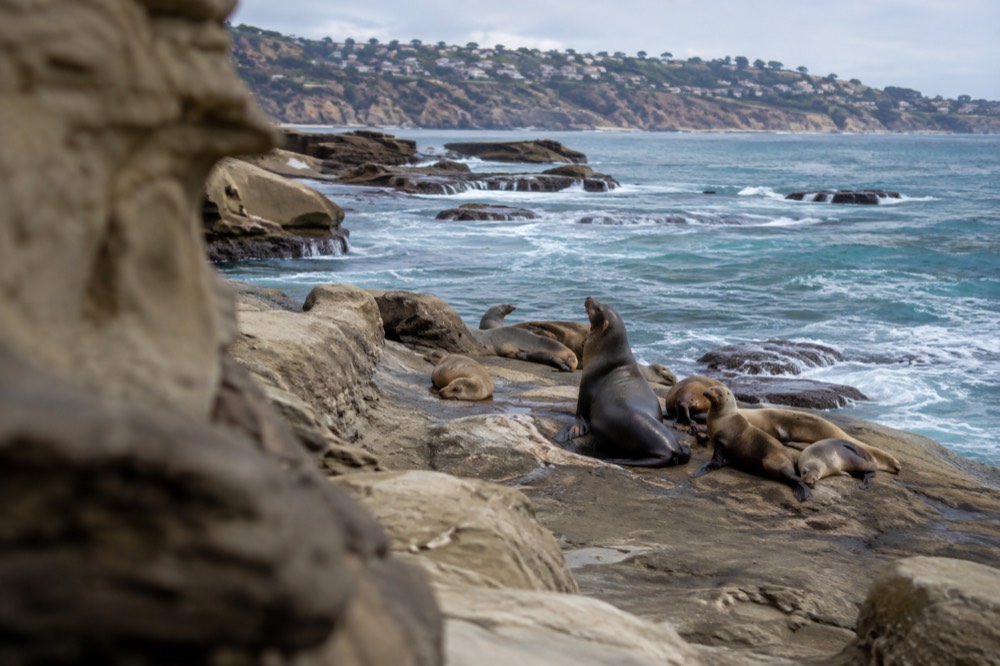
The La Jolla Cove area is small but dense. At the Cove proper, the water is a deep blue-green that photographs almost tropical on a clear morning, and the sea lions haul out on the rocks a few dozen yards from the path. Brown pelicans, one of the most photogenic birds on the Pacific coast, stage on the cliffs. Morning is the right call here for two reasons: the sun is behind you, lighting the water and the animals, and the marine layer, which we cover below, is more likely to have burned off by nine or ten than to still be sitting on the coast.
The sea caves are the shot that La Jolla is famous for. The seven caves are carved into the sandstone between the Cove and La Jolla Shores, and the classic image is shot from the water, looking back into a cave mouth with the sunlight streaming through. A guided La Jolla sea cave kayak tour is the practical way to get that frame, because the guides know which caves are passable on a given swell and which are not. Swell and safety conditions decide the shot, not the clock. Our kayaking La Jolla sea caves guide covers the conditions in detail.
For the wide view, drive or ride up Mount Soledad. The summit looks north over La Jolla Shores and the Torrey Pines State Natural Reserve cliffs, and south over the whole San Diego coastline. It is the one spot where you can show a reader, in a single frame, how the city meets the ocean. Our Mount Soledad guide covers access and the memorial at the top.
Two honest notes for La Jolla photographers. The Children's Pool area has a harbor seal pupping closure in winter, and the exact dates change, so check current signage on site before you plan a shoot around it. And the sea lions at the Cove are protected and close to the path: keep distance, use a long lens, and never position yourself between an animal and the water.
When Is the Light Best, and What Does the Marine Layer Do to Your Shots?
San Diego's best photography light is in late summer and fall: September's normal high of 77.2F beats July's, the ocean is at its warmest from August into September, and rain is nearly absent, with August's normal precipitation at one hundredth of an inch. The marine layer grey the coast most mornings from May through June, so plan coastal shoots for afternoon and skyline shoots for the morning the layer has not reached the bay.
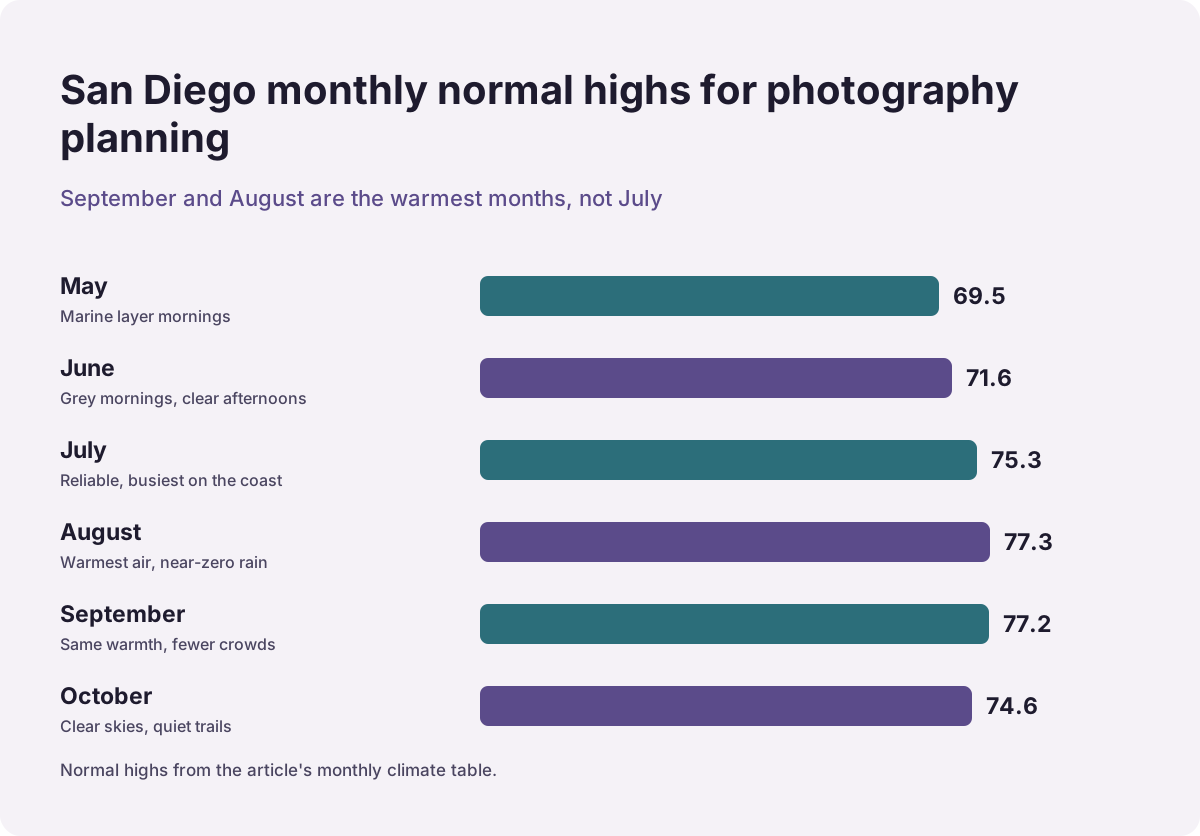
The seasonal numbers matter more here than in most photography guides, because San Diego's light is counterintuitive. June's normal high, 71.7F, is actually lower than October's 74.6F. The reason is the marine layer, the coastal cloud deck locals call May Gray and June Gloom. It sits on the beaches in the morning, thinning or burning back by afternoon. For a photographer this is not a problem, it is a tool: a low grey deck over the water with the sun breaking through produces the most dramatic seascapes on the calendar, and Sunset Cliffs under a breaking marine layer is a better sunrise location than a clear one.
| Month | Normal high F | Normal low F | Rain days (0.10 in or more) | What it means for photography |
|---|---|---|---|---|
| May | 69.5 | 60.0 | 0.7 | Marine layer mornings, dramatic cloud breaks |
| June | 71.6 | 62.6 | 0.1 | Grey mornings, clear warm afternoons |
| July | 75.3 | 66.1 | 0.1 | Reliable, busiest on the coast |
| August | 77.3 | 67.5 | 0.0 | Warmest air, warmest ocean, near-zero rain |
| September | 77.2 | 66.2 | 0.2 | Same warmth, a fraction of the crowds |
| October | 74.6 | 61.5 | 1.1 | Clear skies, warm light, quiet trails |
The September story is the one fact in this guide that surprises even locals. Cabrillo National Monument, the county's best vantage point, recorded its single lowest visitation month in September across 2022 to 2024, at 56,876 recreation visits against July's 83,999, a gap of roughly 48 percent. The warmest light of the year arrives with the emptiest viewpoints. If your trip has any flexibility, September is the month to shoot San Diego.
Where Do You Photograph Wildlife in San Diego?
Wildlife photography in San Diego means three reliable subjects: sea lions and harbor seals at La Jolla, gray whales offshore from mid-December through March with mid-January the peak, and pelicans and shorebirds along the entire coast. The tidepools at Cabrillo National Monument add an intertidal layer, and the best viewing odds are on calm mornings in January and February.
The gray whale migration is the big seasonal prize. The National Park Service, which runs Cabrillo, publishes that more than 20,000 gray whales pass offshore each year, most of them off San Diego in late December, January and February, with mid-January the peak. From land, the Kelp Forest Overlook and the Old Point Loma Lighthouse inside Cabrillo National Monument are the park's own recommended viewing points, and a long lens plus patience is the whole technique. From the water, a three hour whale watch cruise gets you within frame-filling distance of the same animals, and the boats' spotters do the finding for you.
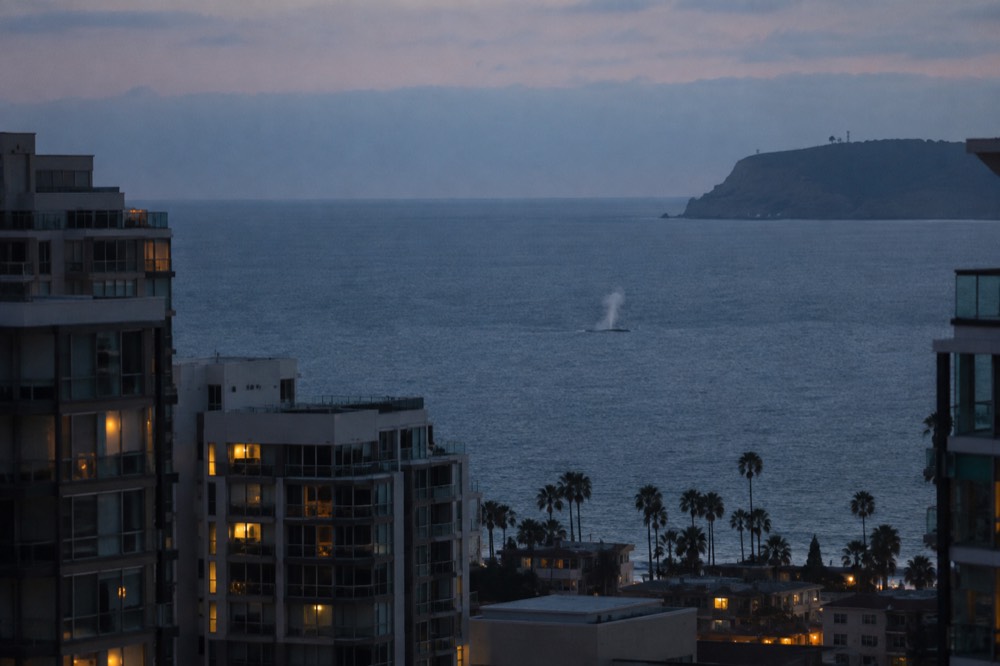
Closer to town, the wildlife is easier. The sea lions at La Jolla are near-guaranteed, and the harbor seals at the Children's Pool haul out year round. Brown pelicans fly the Cove's updrafts all day. The San Diego tide pools guide covers the intertidal shooting at Cabrillo, where low tide exposes anemones and hermit crabs in the rocky benches below the lighthouse. One timing note from the park itself: the tidepools and the whole coastal area close at 4:30 pm, and the Bayside and Oceanside trails close at 4:00 pm, so intertidal work is a morning and midday activity, not a sunset one.
What Should You Know About Shooting at Sunset Cliffs and Point Loma?
Sunset Cliffs Natural Park is San Diego's dedicated sunset location: a mile of sandstone bluffs above open ocean, free to enter, best in the final hour before the sun drops. Point Loma adds Cabrillo's lighthouse, the bay panorama and the tidepools, with staggered closing times that end the day at 5:00 pm sharp, so shoot Point Loma in the afternoon and Sunset Cliffs at dusk.
The sequencing matters. Cabrillo's main gate closes at 5:00 pm and everyone must be out, and the tidepools close at 4:30 pm, so Point Loma cannot host your sunset. But Point Loma's afternoon light is superb: the lighthouse facade faces the afternoon sun, the bay panorama toward downtown is front-lit, and the monument's entrance fee, $20 per private vehicle, valid for seven days, covers a full afternoon of shooting. Sunset Cliffs, by contrast, is a city park with no gate and no fee, and it is precisely built for the last hour of the day, when the low sun turns the sandstone orange and the waves light up below.
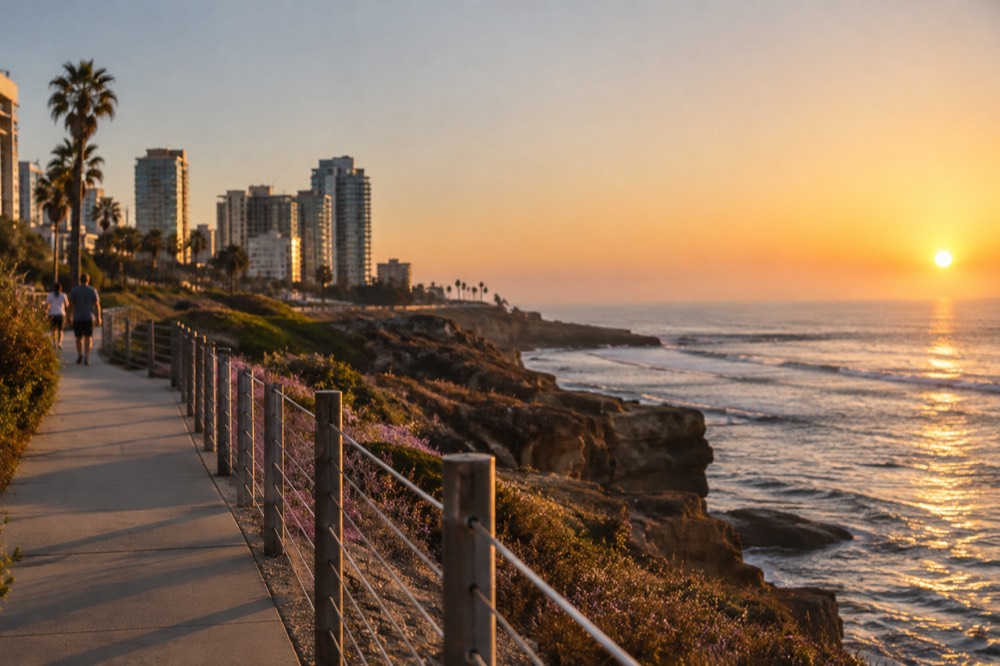
Our Sunset Cliffs Natural Park guide covers the parking situation, which is the practical bottleneck at dusk, and our sunset spots in San Diego roundup places the Cliffs among the alternatives, including Coronado Beach and the Hotel del Coronado, whose red turret silhouettes cleanly against a north-facing sunset. For photographers who want the sun to set over open water with nothing but cliffs and Pacific in the frame, the Cliffs are the only real answer in the city.
What Gear and Practical Planning Do You Need?
You need less gear than you think in San Diego: a wide lens for the coastline, a long lens for wildlife, a tripod for blue hour, and neutral clothing for the wind that comes with every ocean bluff. The practical planning is about parking and closures, not equipment: Balboa Park's lots are paid now but scheduled to go free on 1 January 2027, beach parking is unmetered and scarce in summer, and every coastal park closes at dusk or earlier.
The gear list is short because the light is generous. A polarizer earns its place on the La Jolla water, cutting glare so the turquoise reads at full saturation. A neutral density filter matters only if you want long-exposure wave work at Sunset Cliffs, where 30 second exposures smooth the surf against the rock. Wind is the real coastal constant: every bluff location from Point Loma to La Jolla gets afternoon breeze, so weight your tripod or shoot at faster shutter speeds than you think you need.
| Situation | What to bring | Planning note |
|---|---|---|
| La Jolla Cove morning | Wide lens, polarizer, 200mm plus for sea lions | Arrive before 9:00 am for parking |
| Sea caves from a kayak | Waterproof housing or bag, strap | Swell decides which caves are passable |
| Sunset Cliffs at dusk | Tripod, ND filter, layers for wind | Street parking fills an hour before sunset |
| Cabrillo afternoon | Long lens for whales, shoes for tidepools | Gate closes 5:00 pm, tidepools 4:30 pm |
| Embarcadero blue hour | Tripod, fast lens | Free public promenade, easy transit access |
| Gaslamp at night | Fast prime, small flash or none | Shoot the neon, mind the crowds |
Getting around matters as much as glass. The MTS trolley and bus system charges $2.50 one way with a $6.00 day pass through the PRONTO card, and PRONTO caps automatically, so there is no reason to buy a day pass up front. The getting around San Diego guide covers the network, and the parking in San Diego guide covers the lots and meters honestly, including the Balboa Park situation: paid parking there runs $8 to $16 a day now, with City Council having approved removing it entirely on 1 January 2027.
Balboa Park deserves a final mention as the architecture location. The Botanical Building and Lily Pond, free and open roughly 10:00 am to 4:00 pm daily except city holidays, is the park's most photographed structure, and the Timken Museum of Art is free as well. Early morning, before the Balboa Park crowds build, the arcades and gardens are quiet enough for deliberate composition. If you are planning a longer trip around shooting, the San Diego weather and best time to visit guide has the full month-by-month picture, and Things to Do in San Diego maintains the complete set of location guides for every neighborhood on this list.
For a half-day version of the whole corridor, the city and beaches guided highlights tour covers downtown, the Embarcadero, Coronado and La Jolla with a guide who handles the driving, which is worth considering on days when you would rather compose than navigate.
And for the closing shot of any San Diego portfolio, the small-group sunset sail remains the strongest single option: three hours on the bay, the skyline going gold, then blue, then lit, with the Coronado Bridge in the background and nothing between your lens and the water.
Common Questions About Photographing San Diego
What are the best photography spots in San Diego?
La Jolla Cove, Sunset Cliffs Natural Park, Cabrillo National Monument, the Embarcadero, Coronado Beach, Balboa Park and the Gaslamp Quarter. Together they cover coastline, skyline, wildlife, architecture and night work, and all sit inside the corridor from La Jolla to Point Loma.
When is the best month for photography in San Diego?
September. Its normal high of 77.2F beats July's, the ocean is warmer than in July, and rain is almost absent. It was also the quietest month at Cabrillo National Monument across 2022 to 2024, with roughly 48 percent fewer visits than July, so the viewpoints are empty while the light is at its warmest.
Where can I photograph the San Diego skyline?
From the Embarcadero between the USS Midway and Broadway Pier, which faces the towers across open water, or from the bay itself on a harbor cruise or sunset sail, which compresses the skyline and adds the Coronado Bay Bridge to the frame.
Can I photograph whales from shore in San Diego?
Yes. More than 20,000 gray whales pass each year, mostly from mid-to-late December through March, with mid-January the peak. The Kelp Forest Overlook and the Old Point Loma Lighthouse at Cabrillo National Monument are the park's recommended land viewing points; bring a long lens and go on a calm morning.
What is the marine layer and how does it affect photos?
It is a coastal cloud deck that grey the beaches most mornings in May and June, visible in the climate normals themselves: June's normal high of 71.7F is lower than October's. For photographers it is an asset, producing dramatic cloud breaks over the water at sunrise and clearing to warm afternoons.
Do I need a permit to shoot in San Diego parks?
For personal photography with handheld gear, no. The coastal parks and Balboa Park are free to shoot in, though Cabrillo National Monument charges its standard $20 per vehicle entrance fee. Large commercial productions are a different matter and need arrangements with the managing agency.