Is $100,000 Low Income in San Diego?
A plain answer to whether $100,000 counts as low income in San Diego, what the federal definitions say, and how far that salary stretches for residents and visitors.

Is $100,000 Low Income in San Diego?
No, $100,000 is not low income in San Diego by any official definition, but it also does not feel like a six-figure lifestyle in most of the city, and both halves of that sentence are worth unpacking. The federal Department of Housing and Urban Development publishes county-level income limits every year, and in San Diego County the bar for a household to be counted as low income sits below $100,000 for a family of four. For a single person, the gap between the official threshold and a $100,000 salary is wide, and no program or agency in the county would describe that earner as low income.
That is the technical answer. The lived answer is messier, because San Diego's housing costs eat salaries faster than almost anywhere else in the country, and a household earning $100,000 can still feel priced out of the neighborhoods it wants. Both things are true at once, and this article separates them cleanly so you can plan around whichever one applies to you.
The distinction matters differently depending on who is asking. A resident wondering about rent assistance programs, a senior looking at subsidized housing, or a visitor budgeting a trip all touch the same number from different angles. The sections below take each angle in turn, with the actual costs that make San Diego expensive laid out plainly.
What Does "Low Income" Actually Mean in San Diego?
"Low income" is a federal administrative category, not a vibe, and it is set by county-level income limits that HUD recalculates every single year, which is why any specific dollar figure quoted in an article goes stale the moment the new tables publish. A household is counted as low income when its earnings fall below 80 percent of the area median income for its household size, with separate bands for very low income at 50 percent and extremely low income at 30 percent. San Diego County's median is high enough that these thresholds surprise people from cheaper parts of the country, and that surprise is where most of the confusion around this question begins.
The important part is household size. A single person earning $100,000 in San Diego sits comfortably above the low-income threshold for a one-person household. A family of four on the same total income is closer to the line, because the limits scale up with each additional person, but not by enough to change the verdict for most configurations. The exact figures shift every year when HUD republishes the limits, so any specific number printed in an article goes stale, and the department's own tables are the place to check.
There is a second, informal meaning that locals use constantly, and it is the one behind most Google searches on this topic. In that sense, "low income" means "priced out of the normal San Diego lifestyle," and by that yardstick plenty of $100,000 earners qualify. Rent, childcare, and car costs in the coastal neighborhoods can absorb a six-figure salary without leaving much behind. That is a real condition, but it is a cost-of-living problem, not an eligibility problem, and confusing the two leads people to apply for programs they do not qualify for.
The programs themselves are strict about the numbers. Rental assistance and subsidized senior housing in the county screen against the published limits and household size, not against how squeezed an applicant feels. If you are trying to work out whether you qualify for help, read the eligibility pages for the specific program. Two related questions on this site dig into that from the assistance side: who qualifies for senior housing in San Diego and what the local rental assistance program covers.
How Far Does $100,000 Go for a Visitor or New Arrival?
For a visitor, $100,000 is irrelevant, and for a new arrival it is a genuinely comfortable salary that still demands deliberate choices around parking, neighborhoods, and how you move around the city, because the small daily charges are what define San Diego's cost, not the headline expenses. The costs that define San Diego for travelers are not the mortgage rates, they are the small daily charges: parking, transit fares, and attraction tickets, each of which runs higher than in most American cities, and each of which compounds quietly across a week.

Transit is the one place where San Diego is genuinely cheap. The MTS fare chart lists a one-way bus or Trolley fare at $2.50 with two-hour transfers, and a day pass at $6.00, and the PRONTO card caps your spending automatically so there is no reason to buy a day pass up front. Youth 18 and under ride free entirely. That means a car-free visit to the city is realistic in a way it is not in Los Angeles, and skipping the car is the single biggest saving available to a new arrival deciding where to live. The rest of the planning pages sit on Things to Do in San Diego.
Parking is the opposite story, and it is the expense that shocks people. Downtown meters run $2.50 per hour with enforcement Monday through Saturday, and Sunday is no longer free everywhere since enforcement was extended into commercial areas of Downtown, Uptown, Mid-City and Pacific Beach. In Balboa Park, paid parking is live at $8 to $16 a day depending on the lot and residency status, and the City Council has approved a settlement removing paid parking there entirely on 1 January 2027, so any advice you read about it needs to survive that date. The city's own parking pages are the source of truth: the official Balboa Park parking page and the MTS fare chart between them cover most of what a budget needs.
Attraction prices stack up faster than visitors expect. The San Diego Zoo charges $76 for a one-day adult Any Day ticket, the USS Midway Museum charges $39 online for adults, and Cabrillo National Monument charges $20 per vehicle. None of these are backbreaking on their own. The problem is that a family doing three or four of them in a week, plus parking at each, plus meals in the tourist zones, can burn through a four-figure sum without ever noticing a single large expense.
| Everyday San Diego cost | Typical figure | What changes it |
|---|---|---|
| MTS one-way fare, bus or Trolley | $2.50, 2-hour transfers | Reduced fare $1.25 for seniors 65+, disabled, Medicare, youth with ID |
| MTS day pass | $6.00 | Earned automatically via PRONTO fare capping |
| Downtown meter parking | $2.50 per hour | Some zones enforce to 8:00 pm; Sunday no longer free everywhere |
| Balboa Park lot, non-resident | $10 to $16 per day | Scheduled to end 1 January 2027 |
| San Diego Zoo, adult 1-day | $76 Any Day, $73 Value Days | Online only for Value pricing |
| USS Midway Museum, adult | $39 online, $41 at the door | Active duty military free with ID |
| Cabrillo National Monument, per vehicle | $20, valid 7 days | $10 per person on foot or bicycle |
The pattern in that table is the whole story of San Diego money in miniature. Transit is cheap, parking is expensive, and the attractions sit in the middle. A household that builds its life around the Trolley and the free parts of the city can live well on far less than one that drives to paid parking every day, whatever its income line says.
Where Does the Money Go: Housing and Neighborhoods
Housing is where a $100,000 salary stops feeling like one, and the neighborhood you pick matters more than any single line item on the attraction table, because the spread between the coastal zones and the inland suburbs is effectively a second salary in either direction. Rents and purchase prices in the coastal zones, La Jolla, Coronado, and the central beach neighborhoods run far above what the same money buys inland in Chula Vista, El Cajon, or the North County suburbs. The gap between those two halves of the county is the single biggest financial decision most households here make.
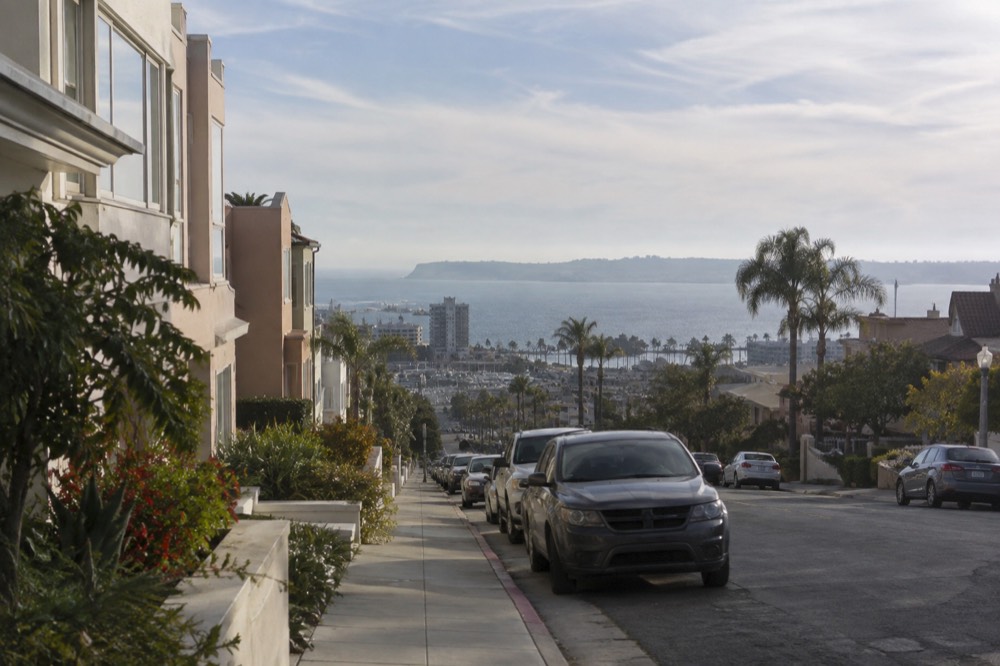
For a visitor this shows up as hotel pricing rather than rent, and the countywide hotel occupancy rate of around 74.2 percent in a year that brought 32.5 million visitors tells you the demand never really slackens. Location premiums are real: staying downtown or at the beach can cost multiples of staying inland and riding the Trolley in. If you are weighing the trade, the site's where to stay in San Diego guide breaks the neighborhoods down properly, and the question of the nicest area to stay in San Diego covers the same ground from the visitor side.
The honest counterweight is that you do not need the expensive half of the city to enjoy it. The neighborhoods worth lingering in are scattered across every price band, and the ones with the strongest character, Old Town, North Park, Little Italy, Coronado's village streets, cost nothing to walk around. A newcomer earning $100,000 who picks an inland base and uses the Trolley is not roughing it. That person is simply spending deliberately, and the difference shows up as money left over at the end of the month rather than a nicer zip code.
One practical note for anyone comparing neighborhoods on a budget: the same logic applies to trips. The San Diego trip cost guide runs the full arithmetic on a visit, and the cheap things to do in San Diego guide proves the low-spend version of the city is still a full city.
Getting around the expensive neighborhoods without paying for parking in each of them is exactly what the hop-on trolley product is built for. It runs for two days across the main sights, which is enough to see Downtown, Balboa Park, and the waterfront without once feeding a meter.
What Can You Do in San Diego on a Tight Budget?
A large share of the best of San Diego costs nothing at all, which is the city's quiet compensation for its punishing fixed costs, and the free layer is not a consolation prize but the actual main attraction: parks, gardens, beaches, and a staffed coastline that most cities would charge handsomely for. The Balboa Park grounds, gardens, and trails carry no admission at all, the Timken Museum of Art is free, the Botanical Building and Lily Pond are free after their restoration, and the Spreckels Organ Pavilion puts on free one-hour concerts every Sunday from 2:00 to 3:00 pm, year round, rain or shine. The park's resident free-day museum rotation is a residency benefit, not a visitor perk, so do not plan a trip around it unless you actually live in the city or county.
The coastline is the same story. The beaches are free, the tide pools at Cabrillo cost only the monument's entrance fee, and sunset spots like Sunset Cliffs charge nothing at all. The city's lifeguards staff nine permanent oceanfront stations covering roughly 24 miles of coastline, so the free version of San Diego comes with real infrastructure behind it, not just unguarded sand. Swimming near a lifeguard, and knowing the rip-current rule of swimming parallel to shore until the pull relaxes, is the extent of the admission price.

Guided walking tours round out the free tier. A pay-what-you-want historic downtown and waterfront walk runs about two and a half hours and is listed on GuruWalk, which is a separate platform from anything sold on this site, and the same platform carries free Old Town and Embarcadero walks. You tip the guide at the end based on what the tour was worth to you. For a visitor watching every dollar, these are the best value in the city, because the guide's local knowledge is exactly what you would otherwise pay a guidebook or a paid tour for.
The budget conclusion for a visitor is blunt: the expensive parts of San Diego are the bed, the car, and the parking, in that order. The city itself, the beaches, the parks, the walking neighborhoods, is one of the cheapest destinations in California once you have landed. A traveler on a modest budget who books inland and rides the Trolley will see more of the city than one who blows the same money on a beachfront room and never leaves it.
For residents, the same logic scales up. The household earning $100,000 that treats the city's free layer as its default and pays for the extras deliberately will feel wealthy. The household that pays coastal rent, drives everywhere, and buys every ticket at the door will feel poor on the same salary. San Diego does not so much punish low income as punish inattention, and the difference between those two households is not the income line at all.
Common Questions About Low Income in San Diego
Is $100,000 low income in San Diego?
No. The federal low-income threshold for San Diego County sits below $100,000 for most household sizes, and a single person on that salary is well above it. It can still feel tight in the coastal neighborhoods, but that is a cost-of-living reality, not an official designation.
What income counts as low income in San Diego?
HUD sets the line at 80 percent of area median income for the household size, with very low income at 50 percent and extremely low income at 30 percent. The county's high median pushes these thresholds above what people expect, and the figures are republished every year, so check the current HUD tables rather than any article's number.
Can you live comfortably in San Diego on $100,000?
Yes, with deliberate choices. Housing is the deciding factor: an inland base near a Trolley line plus the city's large free layer of beaches and parks makes the salary go far, while coastal rent plus daily paid parking can absorb most of it.
Is San Diego too expensive to visit on a budget?
No. Transit is $2.50 a ride with two-hour transfers, Balboa Park's grounds and gardens are free, the beaches are free, and pay-what-you-want walking tours run downtown. The expensive parts are the hotel and the car, and both can be worked around.
Does San Diego have rent assistance for middle earners?
Assistance programs screen against the published HUD income limits for household size, not against how squeezed an applicant feels. A $100,000 household is generally above the eligibility line, but the specific program pages, including the rental assistance question covered elsewhere on this site, are the place to verify.