San Diego International Airport (SAN): Getting Into the City Without Overpaying
San Diego International Airport sits closer to its city center than almost any big airport in the country, and that shapes every decision you make on arrival: the $2.50 bus beats a taxi for speed on most days, the free Flyer shuttle connects you to the trolley, and there is no rail station at the airport itself.
Short answer
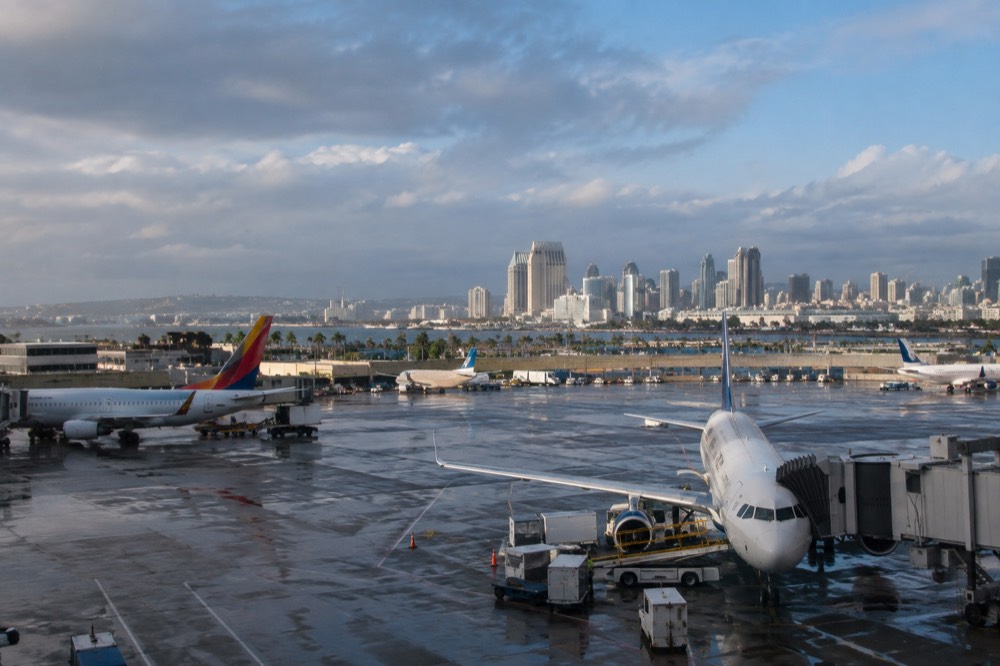
San Diego International Airport (SAN) is about 3 miles from downtown. There is no trolley station at the airport. MTS Route 992 runs downtown every 15 minutes for $2.50, the free San Diego Flyer shuttle connects to the Old Town Transit Center, and rideshare pickup is at marked crosswalks at Terminal 1 and the Transportation Plaza at Terminal 2.
San Diego International Airport, known locally as SAN or Lindbergh Field, is the rare major airport where the city skyline is part of the landing approach. The runway sits on San Diego Bay, downtown is a few minutes' drive from the curb, and the whole geography of the place pushes you toward cheap, fast options rather than an expensive transfer. That closeness is also why the airport has quirks travelers do not expect: no rail link, a departure-level bus stop, and a shuttle system that rewards you for knowing which terminal you land at before you leave the plane.
This guide covers what actually matters once you step into the arrivals hall: the bus downtown, the free shuttle to the trolley, how the PRONTO fare card caps what you pay, where rideshare drivers collect you, and how to fold the airport into a first day in the city without wasting it on logistics. Every fare and schedule figure here comes from the official sources, and the airport's own travel-tips pages fill in the pickup rules.
Where Is San Diego International Airport and How Close Is It to Downtown?
San Diego International Airport sits on San Diego Bay about 3 miles northwest of downtown, close enough that the approach path flies directly over the city center, which is why pilots land from the east and the views on descent are famously good. The airport has two terminals, Terminal 1 and Terminal 2, linked by a free inter-terminal shuttle that runs from the Ground Transportation Plazas outside both. There is no trolley station at the airport, a fact that surprises visitors who assume a city with a rail system would connect it, so every onward journey starts with a bus, a shuttle, a car or your own two feet on the sidewalk.
The two terminals matter more than at most airports because your onward transport depends on which one you exit. Terminal 1 handles most domestic low-cost carriers and is where the Route 992 bus stop sits on the elevated departures level. Terminal 2 is the larger of the two, serves most of the legacy and international traffic, and is where the Transportation Plaza for rideshare sits a short walk away. If you are being picked up by a friend, tell them the terminal before you land, because driving between them on the airport loop takes longer than people expect.
The airport's compactness cuts the other way too. Because the whole facility is squeezed onto the bayfront, there is no room for the sprawling rental car centers you find in Phoenix or Denver. Rental car companies run a shared shuttle from the Ground Transportation Plazas to a consolidated Rental Car Center offsite, and that shuttle, like the inter-terminal one, is free. You do not need to tip for it or book it; it just circulates.
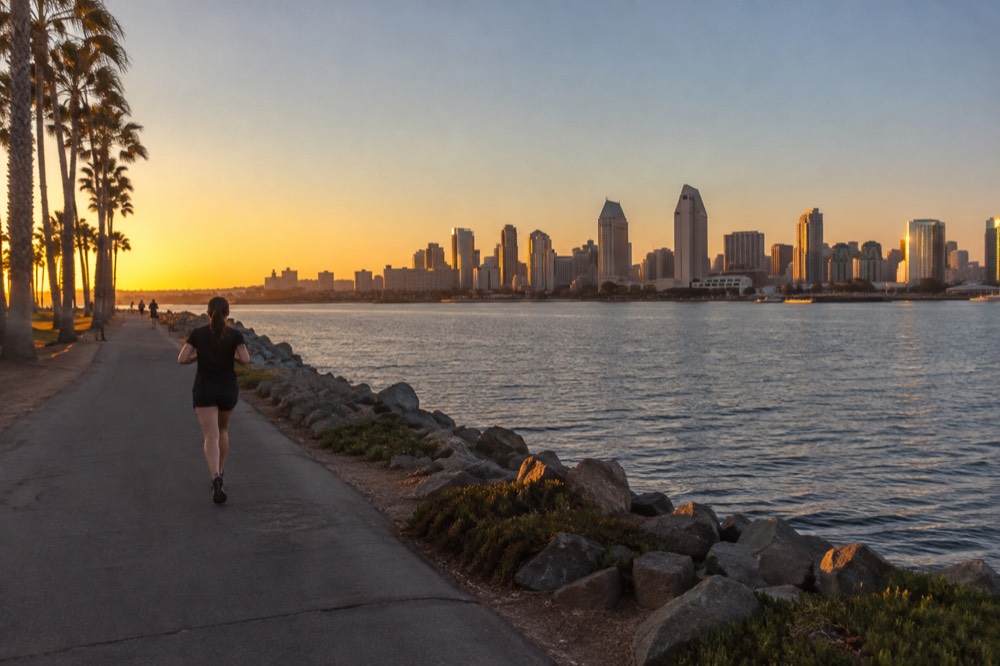
Downtown is close enough that on a clear evening you can see the Gaslamp Quarter's lights from parts of the Terminal 2 curb. For orientation, the neighborhoods that matter to a visitor fan out in a rough arc from the airport: Little Italy and downtown sit east, Old Town sits north, Coronado sits south across the bay, and the beach neighborhoods of Pacific Beach and La Jolla sit up the coast to the northwest. Our downtown San Diego neighborhood guide breaks down which of those bases suits which kind of trip, and it is worth a read before you book a hotel.
How Do You Get from SAN to Downtown Without a Car?
MTS Route 992 is the cheapest and often the fastest way downtown: $2.50 one-way, a bus every 15 minutes, running 4:30 am to 1:00 am daily, stopping at the elevated departures level of both terminals and ending at Broadway and Kettner, America Plaza and Santa Fe Depot, which is the trolley interchange. On a normal traffic day the ride takes only a few minutes longer than a taxi, costs a fraction of it, and drops you inside the downtown core rather than at a hotel door. The San Diego Flyer is the other free option: a no-cost shuttle from both terminals to the Old Town Transit Center, where the Blue and Green trolley lines meet, running roughly 4:45 am to 12:30 am every 20 to 30 minutes.
The choice between the two comes down to where you are sleeping. If your hotel is downtown, in the Gaslamp or in Little Italy, take the 992 and you will be within a short walk of nearly every downtown address. If you are staying in Old Town itself, near Mission Bay, or you simply want the trolley network for a longer stay, the Flyer drops you at a full transit hub with trolley platforms, bus bays and a rail connection, and it costs nothing at all. The airport publishes the Flyer's hours and stop details on its official courtesy shuttle page, which is the page to check the night before you fly, since shuttle schedules are the one thing that changes seasonally at SAN.
| Option | Cost | Frequency | Where it takes you | Best for |
|---|---|---|---|---|
| MTS Route 992 bus | $2.50 one-way | Every 15 min, 4:30 am to 1:00 am | Broadway & Kettner, America Plaza, Santa Fe Depot | Downtown and Little Italy hotels |
| San Diego Flyer shuttle | Free | Every 20 to 30 min, about 4:45 am to 12:30 am | Old Town Transit Center | Trolley connections, Old Town, Mission Bay |
| Rideshare | Metered by app | On demand | Anywhere | Luggage-heavy arrivals, groups |
| Taxi | Metered | On demand | Anywhere | Fixed-price peace of mind late at night |
| Rental car shuttle | Free | Circulating | Offsite Rental Car Center | Only if a car is genuinely worth it |
One honest note on the last row: most first-time visitors to San Diego do not need a rental car for the first two or three days, because downtown, Balboa Park, the waterfront and Old Town are all connected by transit and short rides. A car earns its cost on the day trips, Julian, Anza-Borrego and Temecula wine country, where transit runs thin. Our getting around San Diego guide lays out that tradeoff in full, and if a car is in your plans, thinking about parking before you drive matters more than the rate itself, as our San Diego parking guide explains.
If your plan for day one is sightseeing rather than checking in and napping, the airport-to-downtown leg pairs naturally with a loop of the city itself, and there are two or three ways to do that without driving:
The hop-on hop-off trolley is the one that fits an arrival day best: it runs a narrated loop past the major sights, your ticket is valid for 2 days, and you can board downtown within a short walk of where the 992 bus drops you. The GoCar option is the fun one for confident drivers, a tiny two-seat vehicle with a GPS narration that steers you through downtown and Old Town or out to the beaches. The USS Midway ticket is the single best first stop on the Embarcadero, and it is a five-minute walk from the Santa Fe Depot end of the 992 route.
Is the Free San Diego Flyer Shuttle or the $2.50 Bus the Better Choice for You?
Take the 992 bus if your hotel is downtown, because it drops you in the middle of the core for $2.50 and runs every 15 minutes from 4:30 in the morning. Take the Flyer if you are heading anywhere the trolley serves, because it is free, it lands you at the Old Town Transit Center where the Blue and Green lines meet, and from there a trolley ride covers downtown, Old Town, Mission Valley and the border. The Flyer also wins for anyone arriving with a family and a pile of luggage, since a shuttle with luggage racks beats wrestling suitcases onto a city bus at a curbside stop.
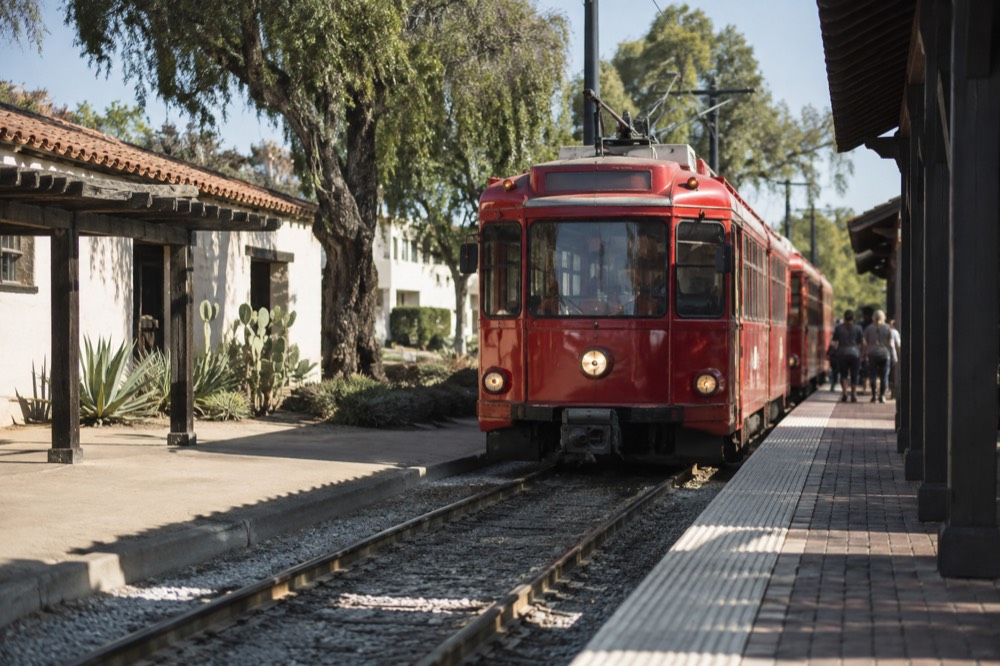
The Blue Line is the line most visitors will ride at some point, and it is worth understanding before you arrive. It runs from San Ysidro at the border, through downtown, up through Old Town and on to UC San Diego and UTC, with a published end-to-end time of 1 hour 23 minutes from San Ysidro to UTC. That single line connects the airport shuttle hub to the waterfront, to the trolley interchange at Santa Fe Depot, and to the university area, which is why landing at Old Town rather than downtown is sometimes the smarter play.
There is one more wrinkle worth knowing: the trolley does not serve the beach neighborhoods directly. Pacific Beach, La Jolla and Ocean Beach are bus territory, and a rideshare from Old Town to the coast is often the pragmatic last leg. That is the honest shape of San Diego transit: excellent along the north-south corridor and downtown, thinner out to the sand. Plan your base accordingly, and read our where to stay in San Diego guide if the beach is the point of the trip.
How Does the PRONTO Card Work and Should You Get One at the Airport?
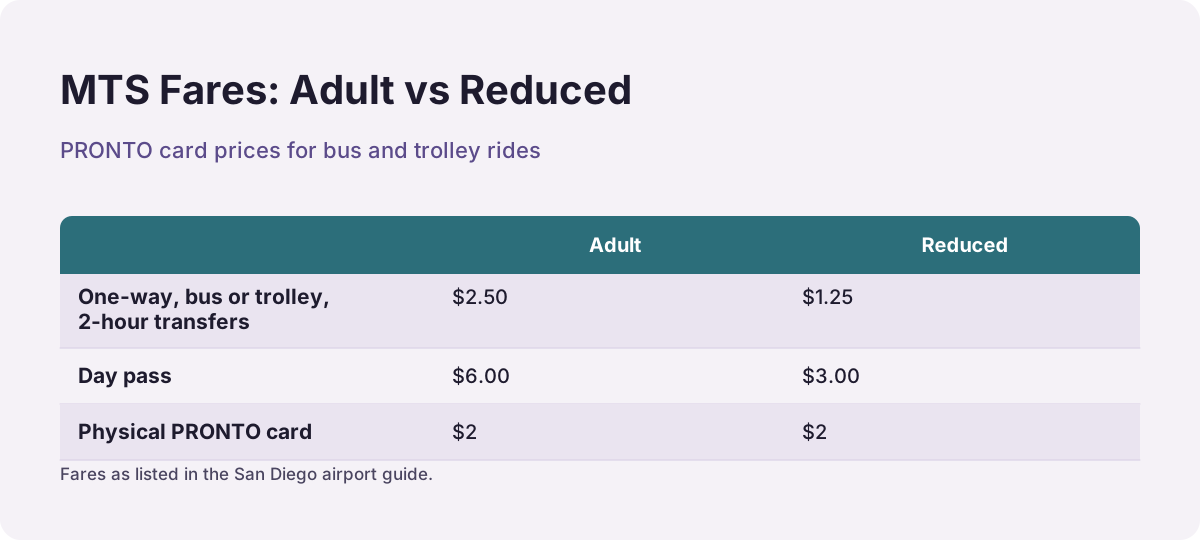
PRONTO is the region's fare system, and its killer feature is fare capping: you load money, pay as you go, and once your rides in a day total the day-pass value the system simply stops charging you, so there is no reason to buy a day pass up front. A one-way bus or trolley ride is $2.50 for adults with 2-hour transfers, a day pass is $6.00, and a physical PRONTO card costs $2 on top of whatever you load, or you can use the free app instead. Reduced fares, $1.25 one-way and $3.00 for a day, apply to seniors 65 and over, disabled riders, Medicare cardholders and youth with ID.
The capping detail deserves a second read because it changes how you ride. With a pay-as-you-go PRONTO card or app, your third ride of the day is effectively free once you have paid the equivalent of two one-way fares, and the official fare chart from MTS, the regional transit agency, spells this out with the phrase "Day Pass Earned." The one trap is contactless bank cards: tapping a credit or debit card works for a single ride, but those taps are one-way only and never cap, so a heavy day of riding on plastic costs more than the same day on PRONTO.
| Fare type | Adult | Reduced |
|---|---|---|
| One-way, bus or trolley, 2-hour transfers | $2.50 | $1.25 |
| Day pass | $6.00 | $3.00 |
| Physical PRONTO card | $2 | $2 |
Two more fare facts save families real money. Youth 18 and under ride free on the Youth Opportunity Pass, so teenagers in your group cost nothing on MTS. And up to two children aged 5 and under travel free with a paying adult, which means a family of four with young kids often pays just two adult fares for a full day of riding. Buy or download PRONTO before you land if you can, because the app sidesteps the $2 card fee and the queue at the transit center vending machine.
Where Do Rideshare and Taxis Pick You Up at SAN?
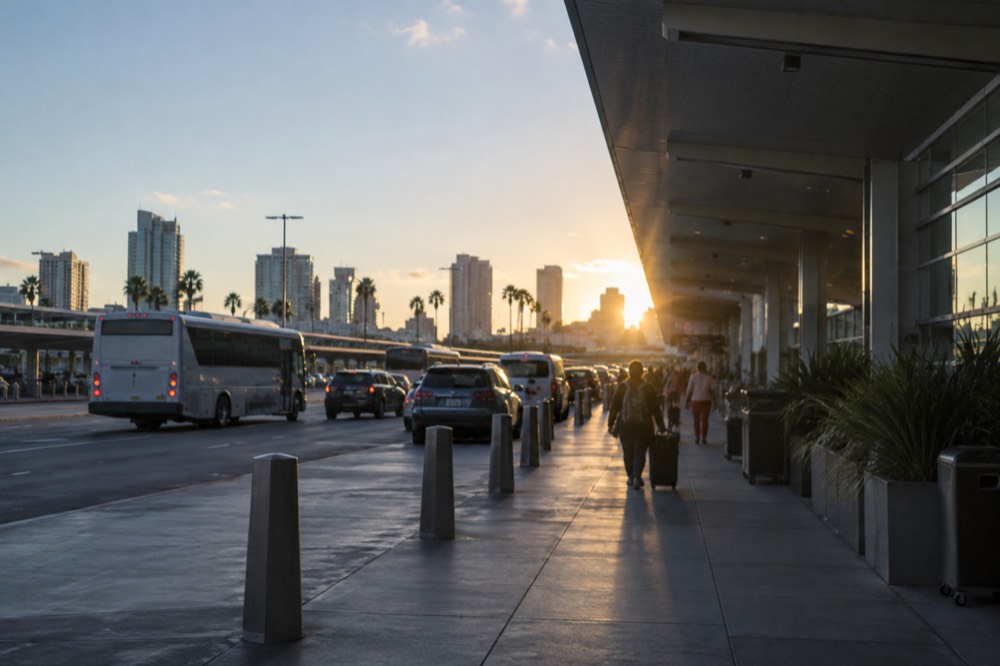
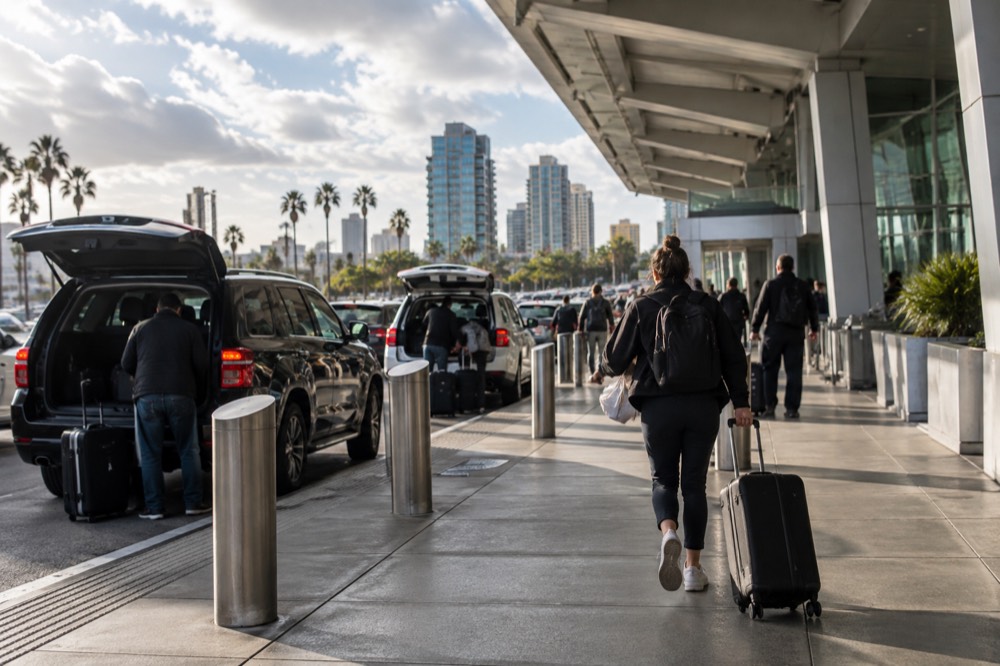
Rideshare pickup at San Diego International Airport is terminal-specific and the airport moved the locations, so the old advice is out of date: at Terminal 1 you exit baggage claim and cross at the pedestrian crosswalk, while at Terminal 2 you exit baggage claim, use the main crosswalk to the Transportation Plaza and head to the second lane. Drop-offs, by contrast, stay curbside at both terminals, which is why the departures level at Terminal 1 doubles as the 992 bus stop and everything feels compressed into the same few hundred feet of curb. The airport's official ride services page is the source for these locations and is worth a glance while you wait at baggage claim.
The practical consequence is simple: do not walk to the wrong spot. Terminal 2's Transportation Plaza is a genuine plaza with marked lanes, and drivers wait in a queue there rather than circling, so your pickup is usually quicker than at Terminal 1's crosswalk arrangement, where cars pull up on the street side. Taxis use the same plazas and meter by distance, and because the airport is so close to downtown, the fare difference between a taxi and a rideshare for a downtown hotel is usually small enough not to matter. The rideshare decision matters far more for beach destinations, where the distance, not the pickup, sets the price.
If someone is collecting you by private car, the honest advice is to have them wait at the Cell Phone Lot and drive in once you have your bags, since the airport loop gets congested at peak arrival waves in the late morning and early evening. And if you are the one doing the collecting, the free inter-terminal and [Rental Car Center](https://economybookings.tpk.ro/SOfY7WRc) shuttles mean you never need to enter the terminal curb at all, you can stage from the Ground Transportation Plaza and meet on foot.
Do You Need a Rental Car After Landing at San Diego International Airport?
Most visitors need a rental car for only part of their trip, not all of it: downtown, Balboa Park, Old Town, the Embarcadero and the zoo corridor are all reachable by trolley, bus or a short rideshare, while the worthwhile day trips, Julian, Anza-Borrego, Temecula and the Anza desert, genuinely require driving. The smart pattern many travelers land on is a transit-and-rideshare base in the city for a few days, then a car for one or two days of inland exploring, which avoids paying for a vehicle to sit in a hotel garage at downtown meter rates of $2.50 per hour.
The parking math is what usually decides it. Downtown meters charge $2.50 an hour with enforcement Monday to Saturday, generally 8:00 am to 6:00 pm and later in some zones, and Sunday is no longer reliably free since enforcement was extended into commercial areas. Balboa Park's lots run $8 to $16 a day for non-residents at premium level, though that whole paid-parking arrangement is scheduled to end on 1 January 2027 when City Council's approved settlement takes effect and the lots go free. Hotel parking downtown can sting more than the rental itself. Our parking in San Diego guide tracks all of this, including the beach lots, where the honest answer is that parking is free to find and very hard to find in summer.
| Trip type | Car needed? | Better option |
|---|---|---|
| Downtown, Gaslamp, Little Italy | No | 992 bus, trolley, walks |
| Balboa Park and the zoo | No | Trolley plus a short ride, or the hop-on trolley loop |
| La Jolla, Pacific Beach, Coronado | Usually no | Rideshare or bus, parking is scarce at the coast |
| Temecula wine country | Yes | Book a wine tour and skip the driving instead |
| Julian and Anza-Borrego | Yes | Rent for those days only |
The Temecula row carries a real alternative: a guided wine tour from the city covers three wineries with tastings and lunch over about 5 hours, which removes the designated-driver problem entirely and lets everyone in your party drink. For Julian and Anza-Borrego there is no equivalent, those are drive-it-yourself country, and renting for just those days from a downtown or airport location works fine.
What Should You Do with Your First Day After You Land?
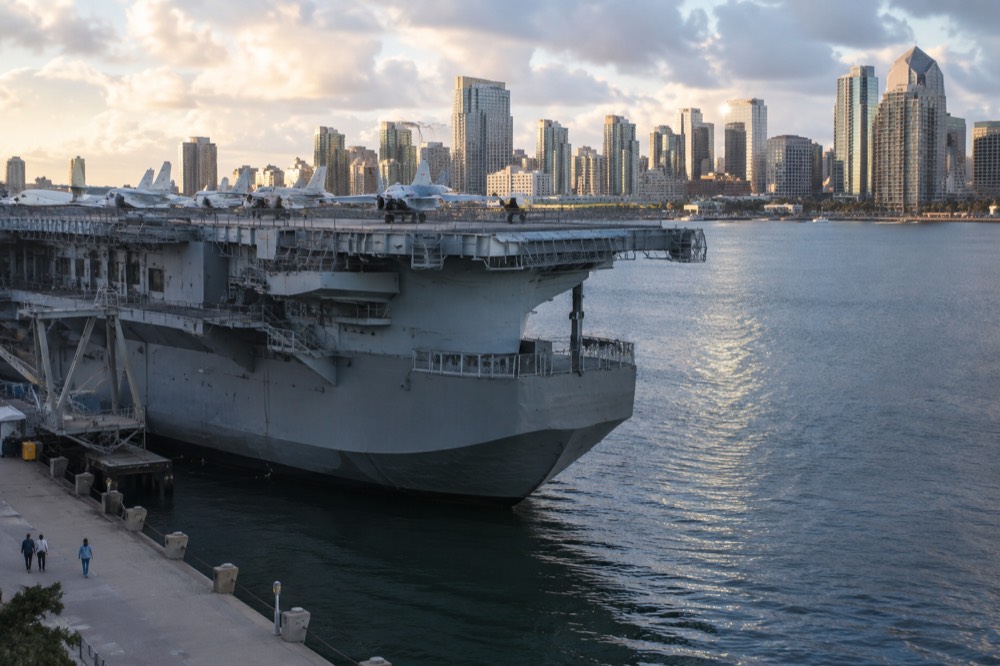
The best first-day plan from SAN is to drop bags at your hotel, walk or ride the short hop to the Embarcadero, and put the USS Midway Museum at the top of the list, because it sits on the waterfront between downtown and the airport approach, the 992 bus drops you within walking distance, and the museum's hours, 10:00 am to 5:00 pm with last admission at 4:00 pm, fit an afternoon arrival. Adult admission is $39 online against $41 at the door, so buying ahead saves a couple of dollars per person, and children 3 and under enter free, as do active duty military with valid ID who collect their ticket at the booth on the day.
The Midway is the single most rewarding first stop because it orients you. From the flight deck you look straight down the bay at the downtown skyline, across at Coronado, and back at the airport runway you just landed on, which is a better geography lesson than any map. Budget two to five hours for the visit; the audio tour is included in admission and the ship is bigger than it looks from shore. Our USS Midway Museum guide covers what to see aboard and how to time it against the crowds.
After the Midway, the Embarcadero gives you the next few hours for free: the waterfront promenade, the maritime museum ships along the same stretch, and Seaport Village at the southern end are all walkable and none of them charge for the stroll. If your legs are still going, the Gaslamp Quarter begins a few blocks inland, and the Gaslamp Quarter area guide maps the restaurants and bars worth the detour. Sunset from the waterfront faces west over the bay, and it is one of the easiest good sunsets in the city to reach on a jet-lagged first evening.
What Should You Know About San Diego Weather Before You Land?
San Diego's warmest month is not July but August, with a normal high of 77.3F, and September runs it nearly level at 77.2F while the ocean is at its warmest, 68.7F on average in August against 66.5F in July, so an early-fall arrival often gets better beach weather than a midsummer one. The counterintuitive detail is that September is also the quietest month at Cabrillo National Monument, with 56,876 recreation visits across the recent three-year pattern against July's 83,999, a gap of roughly 48 percent, which means the best weather of the year arrives with the thinnest crowds.
The marine layer is the other thing to pack for. June's normal high, 71.7F, is lower than October's 74.6F, and that inversion is the fingerprint of the coastal cloud locals call May Gray and June Gloom: grey mornings on the coast while inland areas stay clear, usually burning off by midday. If you land in early summer expecting relentless sunshine and the ceiling is flat and grey, you have not been cheated, you have met the local climate doing exactly what its 30-year normals say it does. The San Diego weather and best time to visit guide unpacks the month-by-month pattern, including the fact that rain is almost entirely a December-through-March phenomenon, with August averaging one hundredth of an inch.
How Early Should You Arrive at SAN for a Departure?
Arrive two hours before a domestic departure and three hours before an international one, because SAN is a compact airport with a single runway and limited gate space, which means security lines move in surges rather than steadily, and the terminals fill quickly during the morning bank of departures. The airport's small footprint works in your favor once you are through, everything is a short walk, food and seating are close to the gates, but it works against you before that, because there is no sprawling terminal to absorb a queue. Early morning and late afternoon are the surge windows.
The single runway is the operational fact that explains most of the airport's personality. It constrains the departure rate, it makes the approach over downtown one of the more dramatic in American aviation, and it means weather or a late inbound aircraft ripple through the schedule faster than at a hub with spare capacity. Checking your flight status before you leave your hotel is genuinely useful here rather than a nervous tic, and the airport's own pages are the reliable source for terminal assignments, which do shift when airlines adjust schedules.
If you are heading back to the airport from downtown at the end of your trip, the same transport logic runs in reverse. The 992 picks up on Broadway and at Santa Fe Depot for $2.50, the Flyer runs from Old Town for free, and a rideshare from downtown is a short, cheap hop that avoids the bus entirely if you are carrying more than you were on arrival. Leave more margin than the distance suggests, because the airport loop itself can be the slowest part of a departure at peak times.
Which Airport-adjacent Plans Are Worth Booking Before You Fly?
Book three things before you land if any of them are on your list: a hop-on hop-off trolley ticket for the city loop, a USS Midway entry ticket to lock the online price, and a Temecula wine tour if your trip stretches long enough for a day inland, because all three sell against date-based availability and the trolley and Midway pair naturally with a transit-based arrival. The trolley ticket is the one that changes the shape of a first trip most, since a 2-day narrated loop past the major sights removes the need to learn the bus network on day one, and you can board within a walk of the 992's downtown stops.
The GoCar tour earns a booking too, though for a different reason: it is the format that suits travelers who want the freedom of a car without the parking problem, a two-seat GPS-narrated vehicle that steers you through downtown and Old Town or out toward the beaches on a 2-hour route. It pairs well with a mid-trip day once you have your bearings, and it is a very different animal from the trolley, which is exactly why the two sit side by side in most visitors' plans.
For the rest, this site, Things to Do in San Diego, carries deep guides to every neighborhood and attraction you can see from the runway, and the honest summary is that the airport's closeness is a gift you should spend. A visitor who lands at noon can be standing on a museum ship by one, on a beach by four, and eating tacos in Little Italy by seven, all on $2.50 of transit and a pair of comfortable shoes. Few big-city airports offer that trade, and planning around it is the single best decision you can make before the cabin door opens.
Common Questions About San Diego International Airport
How far is San Diego International Airport from downtown?
About 3 miles. The airport sits on San Diego Bay immediately northwest of downtown, close enough that the landing approach flies over the city center and the skyline is visible from the terminal curb.
Is there a trolley station at San Diego International Airport?
No. There is no rail or trolley station at the airport. The connections are MTS Route 992, a $2.50 bus that runs downtown every 15 minutes, and the free San Diego Flyer shuttle to the Old Town Transit Center, where the Blue and Green trolley lines meet.
How much is the bus from San Diego airport to downtown?
$2.50 one-way on MTS Route 992, with 2-hour transfers included. The bus runs every 15 minutes from about 4:30 am to 1:00 am daily and stops at the elevated departures level at both terminals, ending at Broadway and Kettner, America Plaza and Santa Fe Depot.
Is the San Diego Flyer shuttle really free?
Yes. The San Diego Flyer runs free from both terminals to the Old Town Transit Center, roughly every 20 to 30 minutes from about 4:45 am to 12:30 am. No ticket or booking is needed; you just board at the shuttle stop.
Where does rideshare pick up at San Diego airport?
At Terminal 1, exit baggage claim and cross at the pedestrian crosswalk. At Terminal 2, exit baggage claim and use the main crosswalk to the Transportation Plaza, then head to the second lane. Drop-offs remain curbside at both terminals.
Do I need a rental car in San Diego?
Not for the city itself. Downtown, Balboa Park, Old Town and the Embarcadero are all reachable by trolley, bus or a short rideshare. A car earns its cost on the inland day trips, Julian, Anza-Borrego and Temecula, so many visitors rent for just those days rather than the whole stay.