Point Loma San Diego: Best Things to Do, Cabrillo, Tide Pools and Views
Point Loma is the rocky thumb of land that guards the entrance to San Diego Bay, and it holds some of the best views, the best tide pools and the best sunsets in the city. Here is how to plan a day on the peninsula.
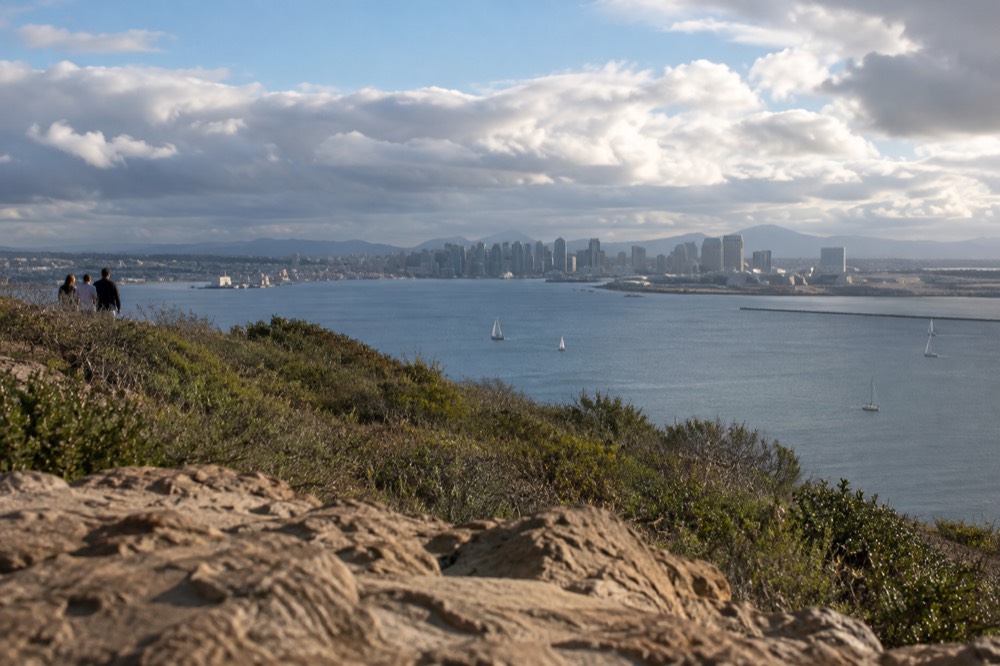
Short answer
Point Loma's headline attraction is Cabrillo National Monument, which charges $20 per vehicle, opens 9:00 am to 5:00 pm, and closes its tide pools at 4:30 pm. Add the Old Point Loma Lighthouse, gray whale watching from the Kelp Forest Overlook in January and February, the Liberty Station Public Market and the cliffs along the western shore.
Point Loma is the peninsula that defines San Diego's skyline from the sea side. Sail into the bay past it, as the Navy does tens of thousands of times a year, and you understand why the military has never left: every ship passes under its watch. Drive out Rosecrans Street on a clear afternoon and the whole city arranges itself below you, downtown to the left, Coronado straight ahead, the Pacific dropping away to the right off sandstone cliffs.
The peninsula splits cleanly into four experiences. Cabrillo National Monument and the lighthouse sit on the tip. The western shore is cliff and surf, running down toward Sunset Cliffs. Liberty Station, the old Naval Training Center turned into a park, market and arts district, anchors the north. And Shelter Island and Harbor Island, technically their own strips of landfill, give you the bay-side hotels, marinas and fishing fleet. You can do the tip and the cliffs in one afternoon. Doing all four well takes a full day.
If you want the short version: buy nothing in advance except your tour tickets, arrive at Cabrillo before 10:00 am, work the tide pools on the way down, and save Liberty Station for lunch. The rest of this page fills in the details.
What Is Point Loma Known For?
Point Loma is known for three things: Cabrillo National Monument, where a $20-per-vehicle entrance fee buys the best panoramic view in San Diego County; the tide pools and sandstone cliffs along the western shore; and its military and maritime history, from the Old Point Loma Lighthouse to the Fort Rosecrans hillsides and the sport-fishing landings on Harbor Island. Gray whales pass the point in winter, visible from shore.
The name itself is older than the city. Spanish explorers charted the peninsula as a "point," and the rocky spine that runs its length gives the rest. What surprises most first-time visitors is how much of Point Loma is not built on. The southern tip is a national monument, the western cliffs are largely open coast, and Fort Rosecrans National Cemetery and active Navy land hold large tracts. The peninsula feels quieter than the postcard neighborhoods, and that is exactly its appeal.
It is also, geographically, where San Diego's weather shows its seams. The marine layer that locals call May Gray and June Gloom sits hardest on the coast, and Point Loma's western shore faces the open Pacific. On a June morning the cliffs can be grey and cold while inland neighborhoods sit in sun, and the fog often burns off at the point last. Plan morning activities that do not need a view, and save the panoramas for afternoon.
For orientation, the narrated Hop-on Hop-off Trolley Tour is a sensible first-day move. The two-day ticket loops downtown, Balboa Park and the Embarcadero, and once you have the city laid out in your head, Point Loma's geography makes much more sense: it is the headland you saw across the bay from the USS Midway's flight deck. The Midway itself, moored on the downtown waterfront, is the natural pairing for a Point Loma afternoon, since both are Navy stories told from opposite sides of the bay.
Is Cabrillo National Monument Worth Visiting?
Yes, and it is Point Loma's single best stop. For $20 per vehicle, valid for seven days, you get the highest panoramic view of San Diego, the Old Point Loma Lighthouse, a military history exhibit, the Kelp Forest whale-watching overlook and access to one of the best tide pool areas in Southern California. The park is open daily 9:00 am to 5:00 pm, closed only on Thanksgiving and Christmas Day.
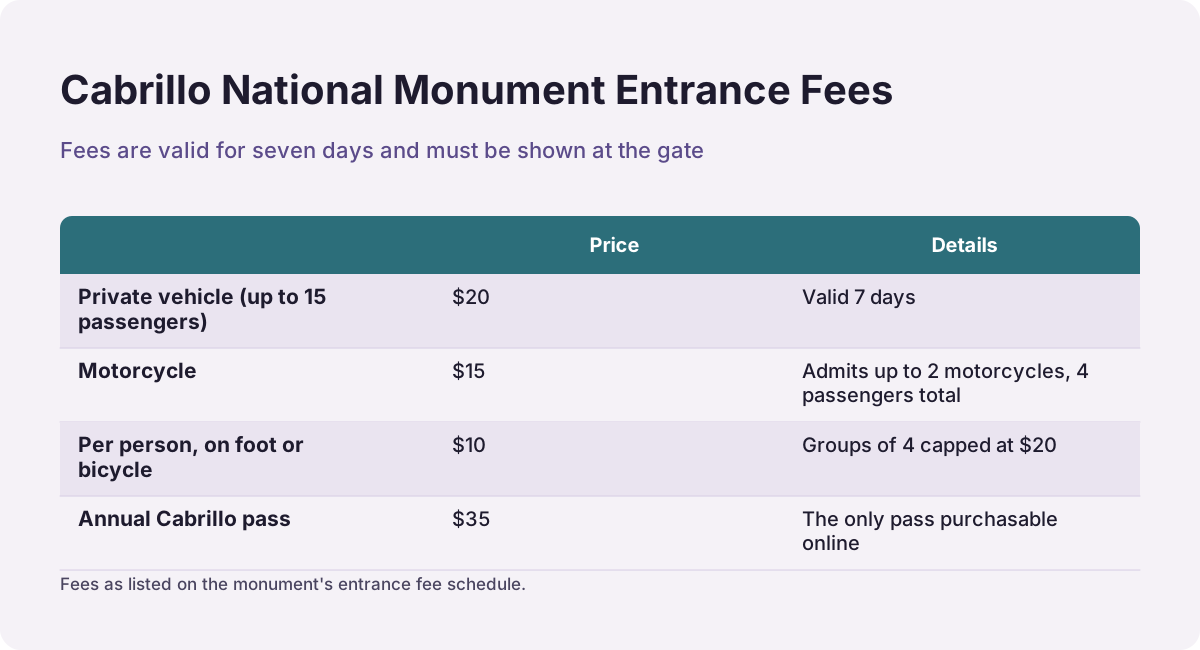
Cabrillo National Monument is one of the handful of places in the country where you can stand on a headland and watch the Pacific meet a major harbor. The park's own pages lay out the practical details, and they are worth reading before you go: the entrance fee table and the staggered closing hours both matter to your plan.
The fees are simple. A private vehicle up to 15 passengers pays $20, a motorcycle $15, and walkers or cyclists $10 per person, with a group of up to four on foot capped at $20. An annual Cabrillo pass costs $35, and America the Beautiful passes, including Senior and Military passes, are accepted. One detail that catches people out: passes must be physically presented at the entrance station. Receipts and photographs are not valid for entry. Only the Cabrillo Annual Pass can be bought online and shown digitally.
| Cabrillo entrance fee | Price | Notes |
|---|---|---|
| Private vehicle (up to 15 passengers) | $20 | Valid 7 days |
| Motorcycle | $15 | Admits up to 2 motorcycles, 4 passengers total |
| Per person, on foot or bicycle | $10 | Groups of 4 capped at $20 |
| Annual Cabrillo pass | $35 | The only pass purchasable online |
| America the Beautiful passes | Accepted | Senior and Military passes included |
The closing sequence is the part to plan around, because the park does not shut down all at once. The Bayside and Oceanside trails close at 4:00 pm. The tide pools and the entire coastal area close at 4:30 pm. The lighthouse and exhibits stay open to 5:00 pm, and then the main gate closes and everyone must be out. There is no public access before 9:00 am or after 5:00 pm at all, including for walkers and joggers, so sunrise photos from inside the park are not an option.
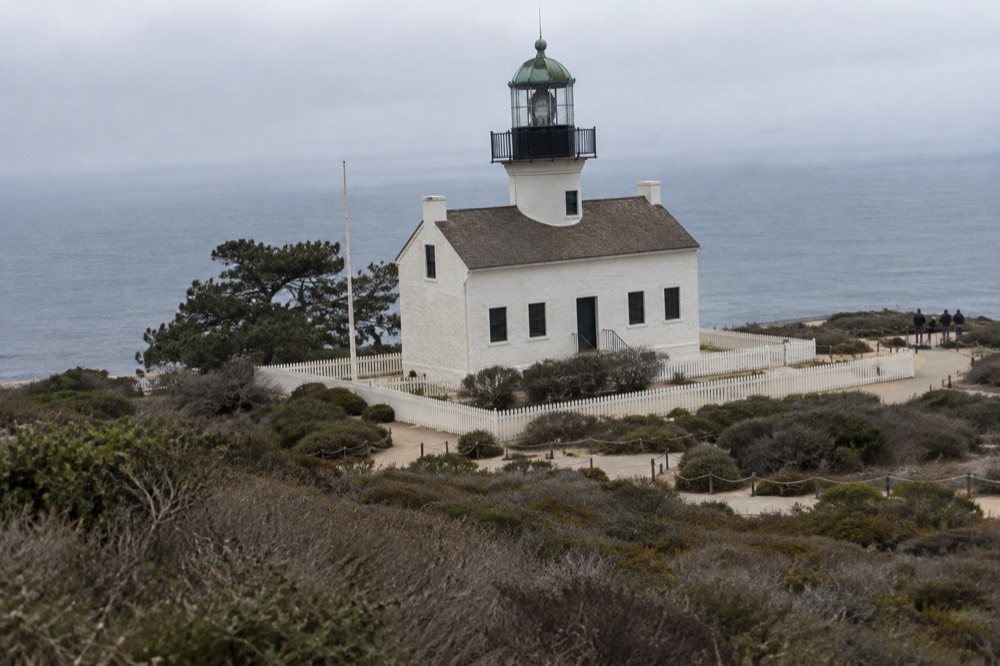
The lighthouse itself is small and quick to see, and the story the park tells about it is honest: the light was eventually moved downhill because fog too often swallowed the original point. The military history exhibit nearby covers the coastal defense guns that once sat on these hills, and the Kelp Forest Overlook outside gives you the whale-watching platform. On a clear January day you can watch for gray whales from the rail with the whole migration passing below.
When Can You See the Tide Pools at Point Loma?
The Cabrillo tide pools are open whenever the park is, but they are only worth visiting at a low tide, ideally a minus tide, and the whole coastal area closes at 4:30 pm daily regardless of the water. Check a tide table for the San Diego coast before your visit, aim to arrive an hour or two before low tide, and wear shoes that can get wet. Winter low tides often fall in the afternoon, which fits the closing time well.
The tide pools sit below the coastal road inside the monument, a short but steep walk down. What you find depends almost entirely on the water. At a good minus tide the shelves expose hermit crabs, anemones, sea stars and sometimes octopus in the deeper pools. At high tide you will see waves and not much else, so this is the one Point Loma activity where checking the tide table genuinely changes your day. The National Park Service publishes tide and safety information, and the general rule is the same one lifeguards give citywide: never turn your back on the surf, and stay back from wet, slick rock near the waterline.
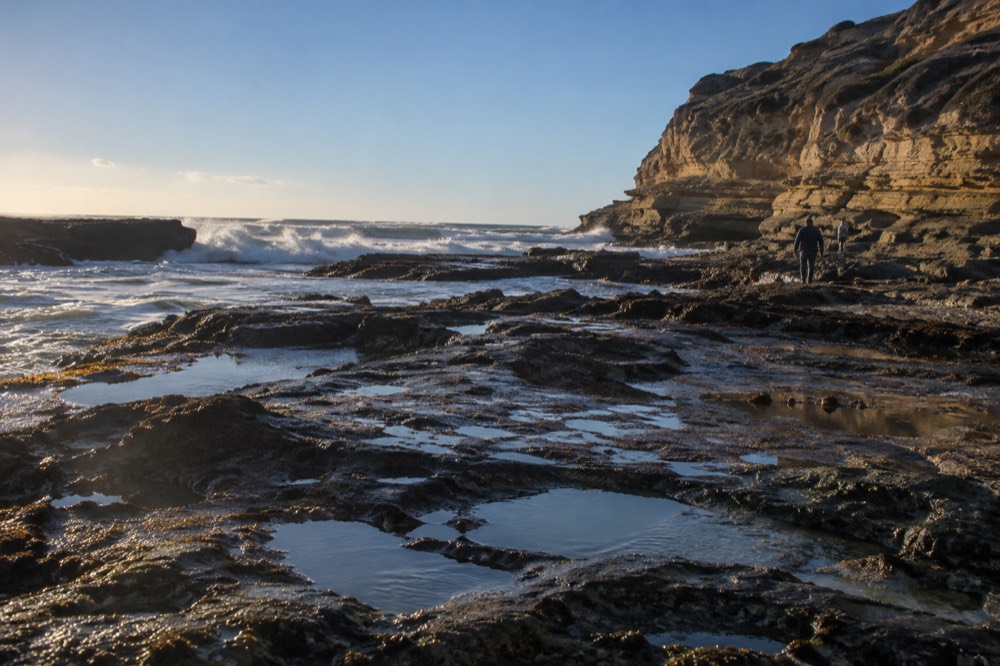
Handle nothing. The park's rules ask visitors to look and not touch, and the pools are a protected area within the monument. That is also why the 4:30 pm closure is enforced firmly: rangers clear the coastal road in the last hour of light, and the walk back up the hill takes longer than people expect. Give the tide pools a full 90 minutes, not a drive-by.
If the tide does not cooperate, swap the order of your day. Do the lighthouse and the overlook first, come back down for the pools on another afternoon, and use the spare time on the cliffs and Liberty Station instead. There is a fuller rundown of the city's other pool spots in the San Diego tide pools guide, including how the sites further north compare.
When Is Whale Watching Season at Point Loma?
Gray whales pass Point Loma from mid-to-late December through March, with mid-January the peak of the migration and January and February the best viewing months. More than 20,000 gray whales pass offshore each year, and the park's own whale-watching page names the Kelp Forest Overlook and the Old Point Loma Lighthouse as the best shore viewing points. Calves heading north linger into March or April.
The numbers come from the National Park Service, and they are the reason winter is a genuinely good time to visit Point Loma rather than an off-season compromise. The park runs a Whale Watch Weekend and Intertidal Festival in late January or early February, timed to the peak. The park's advice on conditions is worth taking seriously: viewing odds are best in good weather, on calm days, or in the morning before the wind picks up. An afternoon on the overlook in February with binoculars is one of the cheapest wildlife experiences in California.
Shore watching is free once you are inside the monument, but it is a long lens proposition: gray whales pass well offshore, and you will see blows and flukes rather than animals filling the frame. If close viewing is the goal, a boat trip is the answer. The 3 Hour Whale Watch Cruise runs out of the bay, and boats leaving the harbor pass right along the Point Loma coast on their way to the whales. Winter weekends sell out, so book ahead for January and February dates.
One caution: the blue whale summer season sometimes advertised for San Diego waters is not something we can confirm against any official source, and this site does not print it. The gray whale window is solidly documented. If you are offered a summer whale trip, treat whales as a bonus and the boat ride as the product.
What Are the Best Views and Walks on the Point Loma Coast?
The Bayside Trail inside Cabrillo National Monument is the peninsula's best walk, a roughly two-mile round trip along the bay side of the headland with the downtown skyline in constant view, and it closes at 4:00 pm sharp. Outside the monument, the cliffs between the point and Sunset Cliffs Natural Park give free ocean-front walking, and Sunset Cliffs itself is the city's best known sunset spot.
The Bayside Trail is the one to prioritize. It starts near the lighthouse and descends gently along the headland's eastern face, with the bay below, naval installations across the water, and downtown stacked up beyond. Because it closes at 4:00 pm and the whole park empties by 5:00, the trail is best done early afternoon, not as a sunset walk. That is the opposite of how most people plan Point Loma, so plan it deliberately.
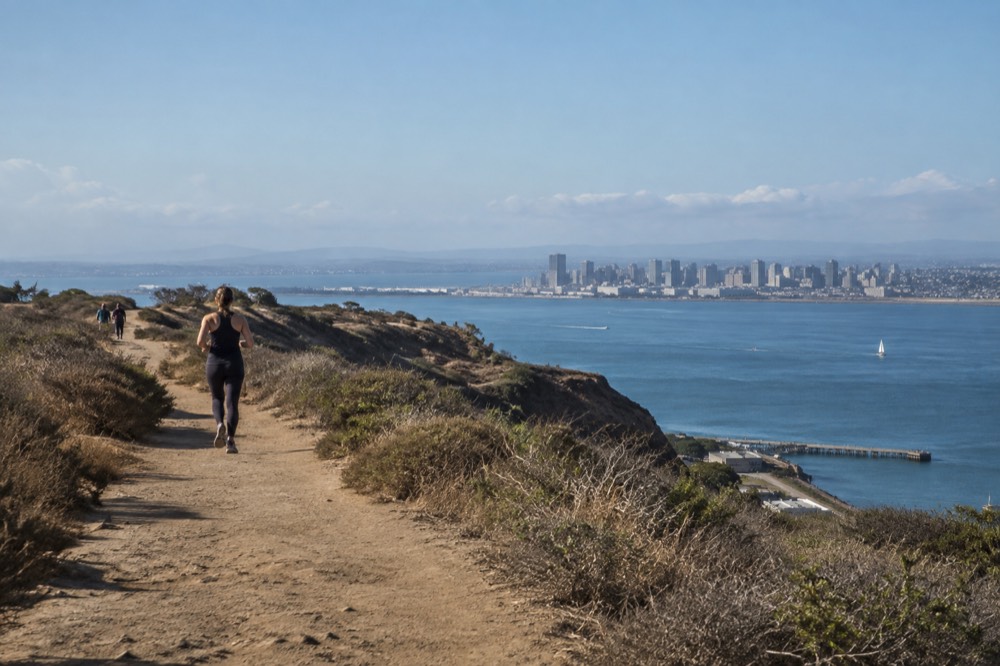
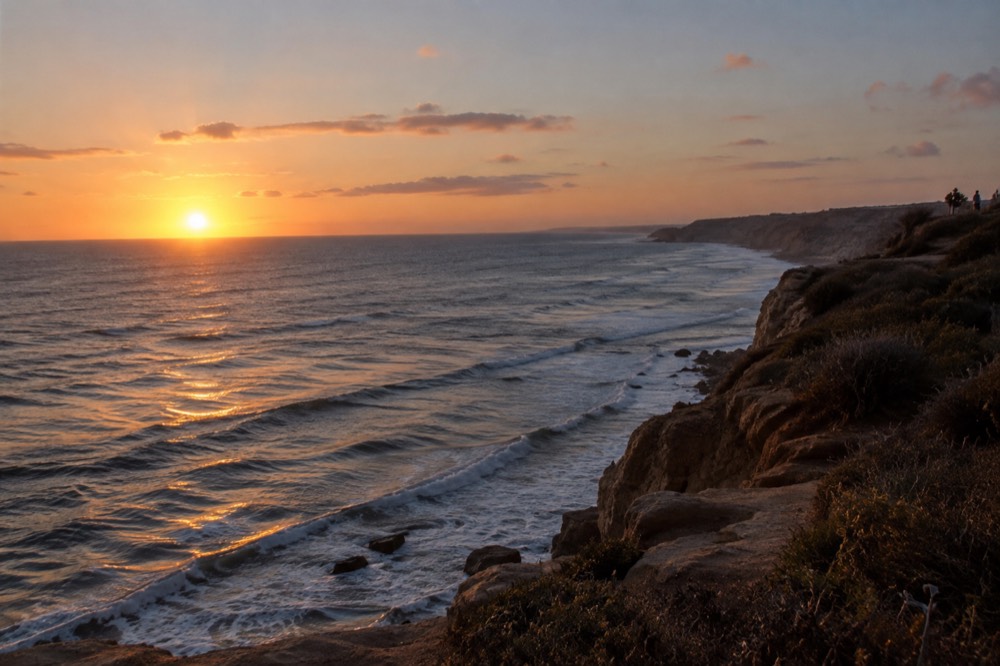
Sunsets belong to the western shore. The Sunset Cliffs guide covers the neighborhood park at the peninsula's southern edge of the cliff line, where the sandstone drops into the surf and the whole sky performs at golden hour. The drive between Cabrillo and Sunset Cliffs along Catalina Boulevard and Sunset Cliffs Boulevard is one of the city's better scenic drives, though the shoulder is minimal and parking near the park at sunset is competitive. Arrive 45 minutes early or expect to walk.
The middle stretch of the peninsula is quieter. There are residential lookouts above the surf line, and the Mount Soledad guide covers the other big panorama in this part of the city, across the bay-side hills in La Jolla. If you are building a photo day, Point Loma in the afternoon light and Sunset Cliffs at dusk is a pairing that costs nothing but gas.
What Is There to Do at Liberty Station and Harbor Island?
Liberty Station, the former Naval Training Center turned public park, holds the Liberty Station Public Market, an arts district, waterfront lawns and the San Diego History Center's Decades exhibit, and it is the best rainy-day and lunch stop on the peninsula. Harbor Island and Shelter Island, across the channel, hold the bay-front hotels, marinas and the sport-fishing fleet, plus calm-water views of the airport approach.
Liberty Station is what a city gets when a military base closes and the land is handed over well. The parade ground is now a wide lawn, the barracks are studios and galleries, and the public market gathers the city's food vendors under one roof. It is the rare San Diego attraction that works equally well in sun and in the marine layer, and it is where to send anyone in your group who has had enough of cliffs and monuments. The Liberty Station guide has the full breakdown of what to eat and which galleries are worth the time.
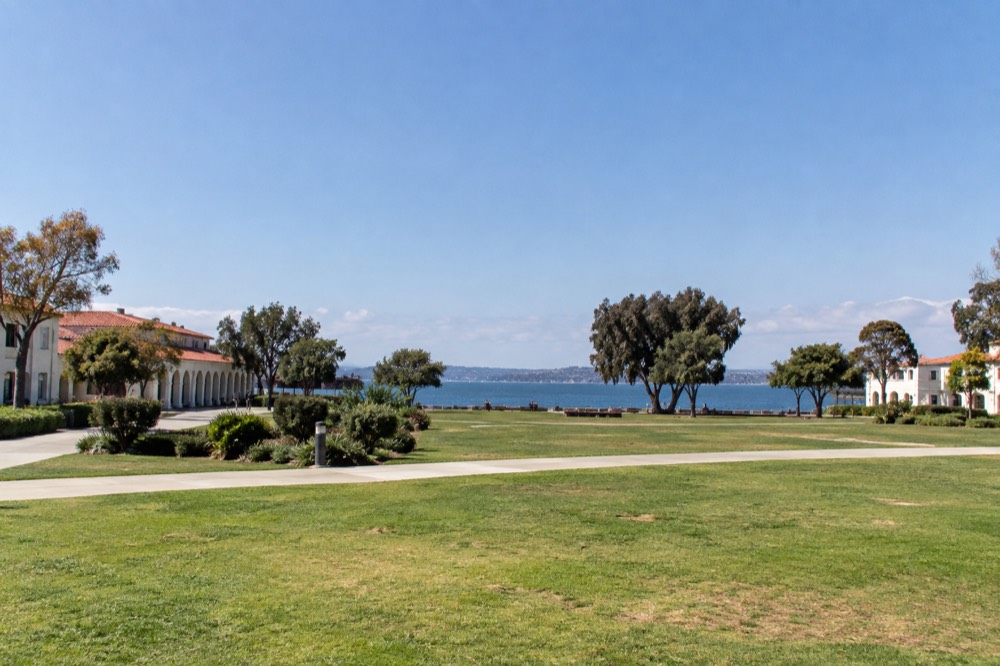
Harbor Island and Shelter Island are thin strips of reclaimed land along the bay side, and they are less attractions than vantage points. Shelter Island's walking path faces the downtown skyline across the water, and Harbor Island's looks back at the airport and Point Loma itself. The fishing fleet docks here, and half-day and full-day sport fishing trips run daily, along with bay cruises. The 1 hour Harbor Cruise is the simplest of these: a loop of the bay that passes under the peninsula's gaze and gives you the naval shipyard, the Coronado Bridge and the downtown skyline from the water, in an hour flat.
If you are staying on the peninsula, these strips are also where the bay-front hotels sit, and the trade-off is real: the views are excellent, the sunsets over the bay are reliable, and you are a drive from nearly everything else. The where-to-stay question gets a fuller treatment in the San Diego neighborhoods guide, but the short version is that Point Loma suits travelers with a car who value quiet and water views over walkability.
How Do You Get to Point Loma and Where Do You Park?
Driving is the practical way in: Cabrillo National Monument is about 20 to 25 minutes from downtown, and parking inside the monument is included in the $20 entrance fee, first come first served. By transit, MTS buses run the length of the peninsula along Rosecrans Street, with an adult fare of $2.50 one-way or $6.00 for a day pass on the PRONTO system. Parking at Liberty Station and Sunset Cliffs is free but tight at peak times.
The transit math is worth a minute. The confirmed MTS fares are $2.50 one-way with two-hour transfers, and $6.00 for a day pass, and the PRONTO card or app caps your rides automatically: once your one-way fares total the day-pass value, the system stops charging you. There is no reason to buy a day pass up front. Youth 18 and under ride free, and up to two children aged 5 and under travel free with a paying adult. The fare chart at sdmts.com is the source for all of this, and posted signs at stops always win if something looks different.
| Getting to Point Loma | Cost | Notes |
|---|---|---|
| Drive from downtown | Free streets, monument parking included | About 20-25 minutes |
| MTS bus on Rosecrans Street | $2.50 one-way | 2-hour transfers included |
| MTS day pass via PRONTO | $6.00 | Earned automatically by fare capping |
| Ride from the airport | Varies by service | About 15 minutes to Liberty Station |
Parking is the honest weak point of the peninsula. Inside Cabrillo, the lots are part of your entrance fee and generally adequate, though the tide pool lot fills on winter weekends when low tide falls midday. At Sunset Cliffs, parking near the best sunset vantage points is competitive an hour before dusk, and on summer evenings it is genuinely hard. We do not quote beach or street parking rates on this site because no published rate table exists for them: treat Point Loma's street parking as free but scarce, and arrive early rather than budget for a lot.
A rental car earns its keep on this peninsula, as it does for the region's inland trips. If your itinerary includes Julian or the desert, having the car for Point Loma day is simply the same decision extended.
What Is the Best Time of Day to Visit Point Loma?
Morning belongs to Liberty Station and the tide pools if the low tide cooperates, midday to Cabrillo's lighthouse and Bayside Trail before the 4:00 pm trail closure, and evening to the western cliffs. September is statistically the best month: its normal high of 77.2F beats July's, the ocean is near its warmest, and the summer crowds have gone, making it the peninsula's quietest premium month.
The climate record backs this up in a way most visitors never hear. September's normal high at the airport station is 77.2F, 1.9F above July's, and the sea-surface temperature at La Jolla averages 67.6F in September against 66.5F in July. Yet September is the single lowest visitation month at Cabrillo National Monument across recent years, running tens of thousands of visits behind July. The locals are wrong-footed by the school calendar, and the weather does not care. If you can visit Point Loma in September, do.
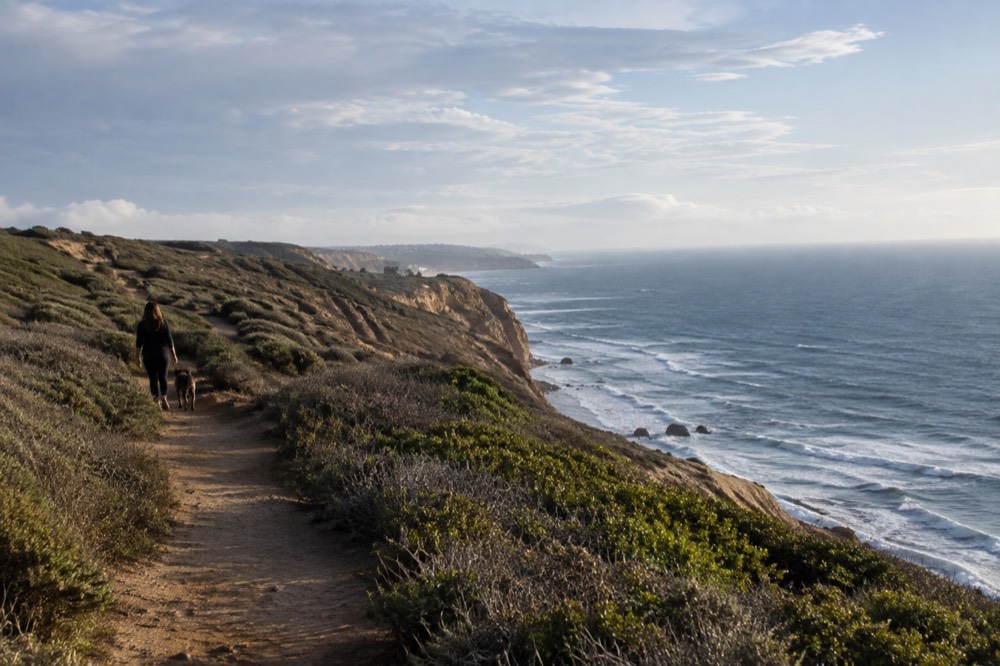
June is the month to manage expectations. The marine layer that locals call May Gray and June Gloom grey the coast while inland stays clear, and the 30-year temperature normals show it plainly: June's normal high, 71.7F, is lower than October's 74.6F. The fog usually burns off at the point by late morning in summer, but a 9:00 am arrival at Cabrillo can mean looking at grey. That is fine for the tide pools, which do not need a view, and less fine for the panorama. Flip your day in June: pools in the morning, overlook after lunch.
Winter has its own case: gray whales, minus tides that fall in daylight, and green hillsides after rain. Rain is a winter phenomenon here, with December through March carrying most of the year's measurable precipitation, but even those months average only about four days with a tenth of an inch or more. A winter visit is a coin flip on sun but a strong bet on whales.
Can You Do Point Loma in Half a Day?
Yes. A half day works if you pick one anchor: Cabrillo with the lighthouse, Bayside Trail and tide pools fills four hours on its own; Liberty Station with lunch and the market fills three. A full day lets you pair Cabrillo in the morning and early afternoon with Sunset Cliffs at dusk, which is the classic Point Loma itinerary and the one we would pick on a first visit.
The sequencing matters more than the length. The monument's staggered closures mean the afternoon has a natural deadline: trails at 4:00 pm, tide pools at 4:30 pm, everything by 5:00 pm. Sunset at the western cliffs comes one to three hours later depending on season. So the classic day runs Cabrillo from late morning, the tide pools timed to the low tide, the Bayside Trail before 4:00 pm, Liberty Station for an early dinner, and Sunset Cliffs for the show.
| Classic Point Loma day | Time | What you are doing |
|---|---|---|
| Liberty Station Public Market | 10:00 am | Coffee and breakfast before the monuments open |
| Cabrillo National Monument | 11:00 am | Lighthouse, exhibits, Kelp Forest Overlook |
| Tide pools | Low tide | Timed to the tide table, coastal area closes 4:30 pm |
| Bayside Trail | 2:00 pm | Bay-side walk, trail closes 4:00 pm |
| Liberty Station dinner | 5:30 pm | Galleries and restaurants in the old base |
| Sunset Cliffs | Golden hour | The peninsula's western face at dusk |
Families should know the trade: Cabrillo's tide pools and the overlook are excellent with kids, but the monument is a looking place, not a running place, and the cliff edges are unfenced in spots. The tide pools are the exception, a natural playground where the rule is touch nothing and hold a hand near the water. For a fuller family plan across the city, the San Diego with kids itinerary places Point Loma in context, and the one day in San Diego plan shows what to cut if you are short on time.
If you are pairing the peninsula with the rest of the city, the natural companions are the USS Midway Museum across the bay, which tells the Navy story from the water side, and the downtown San Diego guide for the evening. That is a full and very San Diego day: ships, cliffs, whales in season, and a sunset that needs no filter. For everything beyond the peninsula, Things to Do in San Diego covers the rest of the county.
Common Questions About Point Loma
How much does Cabrillo National Monument cost?
A private vehicle with up to 15 passengers pays $20, valid for seven days. Motorcycles pay $15, and people arriving on foot or by bicycle pay $10 per person, with a group of up to four capped at $20. America the Beautiful passes are accepted, and every pass except the Cabrillo Annual Pass must be physically shown at the entrance station.
What time does Cabrillo National Monument close?
The main park is open daily 9:00 am to 5:00 pm, closed only on Thanksgiving and Christmas Day. The Bayside and Oceanside trails close at 4:00 pm, the tide pools and the whole coastal area close at 4:30 pm, and everyone must be out by 5:00 pm. There is no access before 9:00 am.
Can you see whales from Point Loma?
Yes. More than 20,000 gray whales pass offshore each year, most visible from mid-to-late December through March, with mid-January the peak. The Kelp Forest Overlook and the Old Point Loma Lighthouse are the best shore viewing points inside Cabrillo National Monument, and odds are best on calm mornings in January and February.
Are the Point Loma tide pools open all day?
The coastal area is open during park hours but closes at 4:30 pm daily. Whether the tide pools are worth seeing depends on the tide: aim for a low or minus tide, ideally an hour or two before it bottoms out, and check a San Diego tide table before you go.
Do you need a car for Point Loma?
It is the practical choice. Cabrillo National Monument is about 20 to 25 minutes from downtown and the transit options are limited to buses along Rosecrans Street at $2.50 one-way. A car also lets you link Cabrillo, Liberty Station and Sunset Cliffs in one day, which is the classic itinerary.
What is the best month to visit Point Loma?
September. Its normal high of 77.2F beats July's, the ocean is near its warmest of the year, and it is the lowest visitation month at Cabrillo National Monument, so you get peak weather with the fewest crowds. January and February are the pick if whales are the priority.